
What if the best time to post isn’t a fixed hour at all? If your content receives uneven reach, conflicting advice about posting days can make planning feel like guesswork. The best time to post on social media UK audiences use depends on the platform, the content and, most importantly, when your own followers are active.
UK timing benchmarks are a useful starting point, but they won’t automatically suit every brand. LinkedIn activity tends to follow a different rhythm from TikTok, and a schedule built for one audience may not work for another. General recommendations can also disagree because studies may examine different audiences, periods and measures of engagement.
This guide sets out practical UK posting windows for major platforms and explains how to use them without treating them as rules. You’ll also learn how to compare your own results and build a simple testing routine, so your schedule reflects evidence from your channels. Timing matters, but it works best alongside relevant creative and a considered content plan.
Key Takeaways
- Use the best time to post on social media UK benchmarks as a starting point, then shape your schedule around your own audience.
- Compare platform timing recommendations carefully: studies can cover different date ranges, account types and measures of engagement.
- Separate audience activity from content distribution and measurable engagement to understand what a “best time” really means.
- Test a small number of posting windows with comparable content, then review audience activity and post-level results in native analytics.
- Build timing into a considered content plan, pairing a sustainable schedule with creative suited to each platform.
Best UK social media post times: what timing can/cannot do
A “best time” is a period when a particular audience is more likely to engage with a post. It’s a useful planning signal, not a promise that publishing at a certain hour will secure attention. The best time to post on social media UK audiences use depends on whose behaviour you want to reach and what you want them to do.
Three measures are easy to confuse. Audience activity describes when people are using a platform. Content distribution is how a platform serves a post to people, including followers and non-followers. Measurable engagement covers recorded actions such as reactions, comments, shares or clicks. A busy audience doesn’t guarantee that a post will be widely distributed, and distribution alone doesn’t mean people will respond.
Why posting time matters to social media performance
Publishing when your intended audience is available can give a post a better chance of receiving early views and responses. Those initial interactions may help it gain attention, but timing is only one part of performance. A relevant idea, strong creative, suitable format and clear audience fit all influence whether someone stops, watches or takes action.
Social media marketing involves more than choosing a time slot. As the overview of Social Media Marketing on Wikipedia explains, it sits within a broader approach to communicating and meeting marketing goals. A posting schedule should support that purpose, not replace it.
A posting-time benchmark is a testable starting point, not a guaranteed formula for reach or engagement. For example, Sprout Social reports Thursday between 4 pm and 11 pm as a broad UK window, while WeAreBrew highlights Tuesday and Wednesday from 11 am to 6 pm. These are different recommendations, not proof that every account should follow either schedule.
Why there is no single best time for every UK account
People’s routines vary. A business audience may check LinkedIn during the working day, whilst customers looking for entertainment may use visual or short-form platforms at different times. Sector and purpose matter too: an event announcement, an educational video and a time-sensitive update may each serve a different need.
National benchmarks describe patterns across the groups and accounts included in a study. They can’t tell you exactly when your followers are available or how they respond to your content. Differences in platform habits and audience routines mean a strong average in one dataset may be a poor fit for a particular account.
Start with a published benchmark as a hypothesis, then compare it with your account’s audience activity and post results. Choose a small number of plausible windows and test them with comparable content. You don’t need a perfect schedule on day one. A consistent, structured approach can reveal useful patterns over time, helping you refine your publishing plan using evidence rather than conflicting general advice.
What 2026 UK social media timing studies say by platform
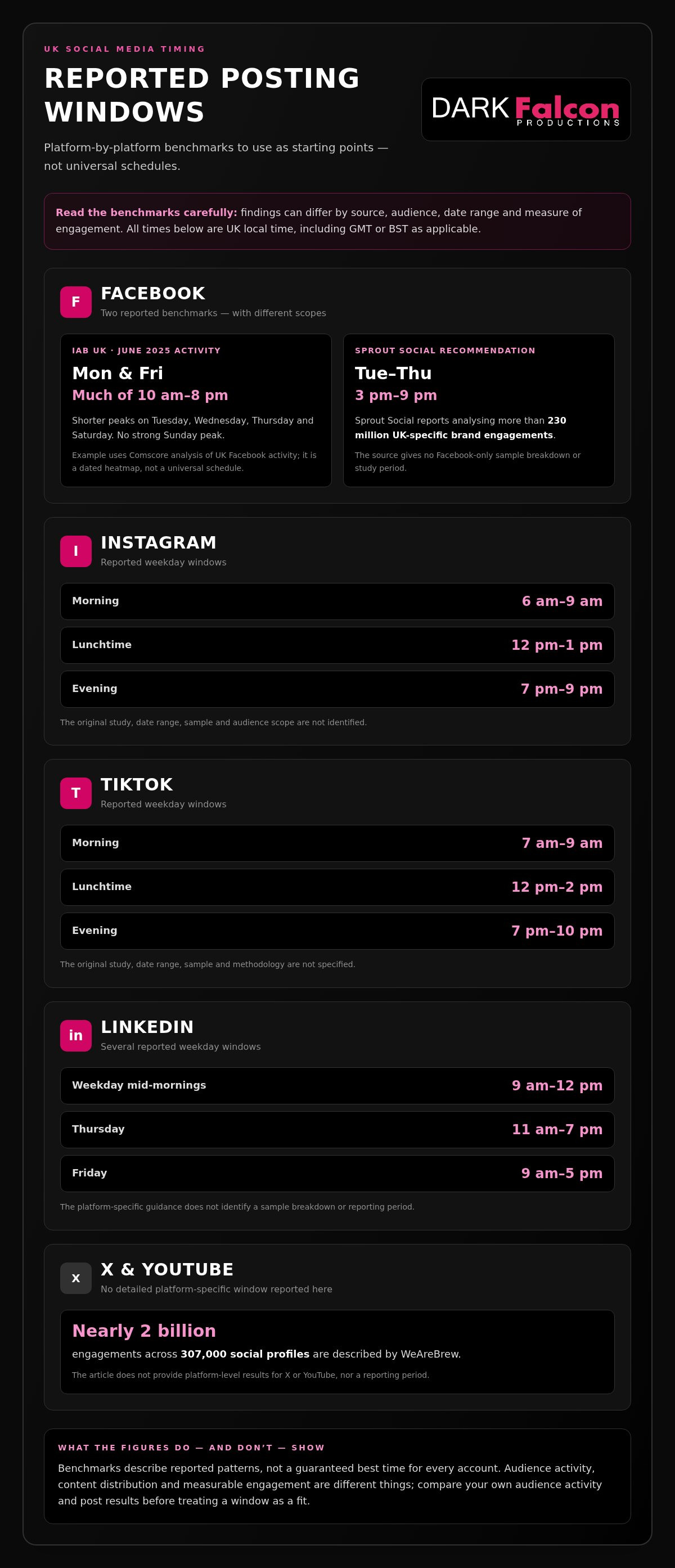
Published findings don’t all measure the same thing. Some report broad audience or engagement patterns; others analyse activity on a particular platform or across brand accounts. The table distinguishes the reported windows from the scope and limitations described by each source. Times are stated in UK local time, including GMT or BST as applicable. The findings don’t provide enough detail to convert every study period into one fixed clock standard.
| Platform | Reported UK window | Source and data period | Audience scope and limits |
|---|---|---|---|
| IAB UK reports Monday and Friday peaks across much of 10 am-8 pm; shorter peaks on Tuesday, Wednesday, Thursday and Saturday, with no strong Sunday peak. | IAB UK’s example uses Comscore analysis of Facebook activity in June 2025. | UK Facebook activity. The example is a dated, platform-specific heatmap, not a universal schedule. | |
| Tuesday to Thursday, 3 pm-9 pm. | Sprout Social’s UK timing recommendation; the source does not state the study period. | Sprout Social reports analysis of more than 230 million UK-specific brand engagements. The source does not give a Facebook-only sample breakdown. | |
| Weekday mornings, 6 am-9 am; lunchtime, 12 pm-1 pm; evenings, 7 pm-9 pm. | UK platform timing findings; the original study and date range are not identified. | Platform-specific recommendation, but the sample and audience scope are not stated. | |
| TikTok | Weekday mornings, 7 am-9 am; lunchtime, 12 pm-2 pm; evenings, 7 pm-10 pm. | UK platform timing findings; the original study and date range are not identified. | UK windows are reported, but the sample and methodology are not specified. |
| Weekday mid-mornings, 9 am-12 pm; other reported windows include Thursday, 11 am-7 pm, and Friday, 9 am-5 pm. | UK platform timing findings; the original study and reporting period are not identified. | Platform-specific guidance, with no sample breakdown provided. | |
| X and YouTube | No detailed platform-specific window is reported in the findings listed here. | WeAreBrew covers these platforms, but its article does not include their timings or a reporting period. | Its article describes nearly two billion engagements across 307,000 social profiles; it does not provide platform-level results for X or YouTube. |
How the UK findings compare across Facebook, Instagram and TikTok
Facebook’s June 2025 Comscore example shows activity across broad daytime periods, while Instagram and TikTok recommendations include distinct morning, lunchtime and evening windows. These patterns aren’t interchangeable: users may approach each platform with different habits, and the findings don’t share a single sample or method. Sprout Social’s Thursday recommendation is a broad UK benchmark, not a replacement for Facebook-specific evidence.
For a dated example, IAB UK’s Comscore Facebook analysis reports UK activity patterns for June 2025. That’s useful context, but it doesn’t establish the best schedule for every platform or account.
What the available data says about LinkedIn, X and YouTube
LinkedIn findings point towards weekday activity, but the reporting periods described don’t support a direct comparison with Facebook’s dated heatmap. WeAreBrew discusses X and YouTube, yet its article doesn’t show their individual time windows. Treat recommendations without platform-specific timings as hypotheses, then compare them with your account data. A considered schedule can be matched with platform-ready creative and social media management.
Why UK recommendations disagree, and how to choose a useful benchmark
Different studies can produce different posting windows without any of them being wrong. Their conclusions depend on what they measured, which accounts they included and when the data was collected. A report based on activity across Facebook in one month isn’t directly equivalent to a multi-platform analysis of brand engagements over a broader period.
For example, IAB UK’s Comscore example covers Facebook activity in the UK during June 2025. Sprout Social describes a dataset of more than 230 million engagements across Facebook, Instagram, LinkedIn, TikTok, X and Pinterest. WeAreBrew cites nearly two billion engagements across 307,000 social profiles. These figures describe different datasets and scopes, so the recommendations shouldn’t be treated as results from one shared experiment.
Check what each timing study actually measures
Before applying a recommendation, look for its publication date, data period, platforms and audience geography. Then check what counts as an engagement. Comscore’s Facebook example concerns total actions, whilst a brand-engagement study may count interactions with brand content. Profile-level activity can describe a wider pattern again. These measures answer related, but not identical, questions.
Also note what the source leaves unspecified. If a report gives a time window but omits its sample, sector mix or method, keep that limitation in mind. Don’t infer that it represents all UK users or a particular industry. Missing detail is a reason to use a finding cautiously, not to fill the gap with assumptions.
Match the benchmark to your platform and audience
Choose the closest available comparison. Start with the platform you use, then consider whether the source’s audience and content purpose resemble yours. A broad consumer-facing benchmark may be a less relevant starting point for a business-to-business account. Treat that as a hypothesis to test, not a fixed rule that every professional audience follows the same routine.
The best time to post on social media UK brands choose should ultimately reflect their own account evidence. Use a relevant benchmark to narrow the options, not to settle your schedule. For instance, if a source points to weekday activity on your platform, test a couple of suitable weekday windows rather than copying a recommendation from another platform or sector.
- Check the date: note when the data was gathered, not only when an article was published.
- Check the scope: confirm the platform and whether the findings are UK-specific.
- Check the measure: distinguish audience activity from actions on brand posts.
- Check the fit: consider account types, sectors and content purposes in the sample.
Once you’ve selected a close match, treat it as your working hypothesis. Compare it with your audience activity and post-level results before adopting a regular schedule. This gives the benchmark a clear role: it helps you start with a reasoned test, while your account data guides the next decision.
How to find your own best time to post on social media
Use published UK timings to choose sensible test windows, then let your account results shape the schedule. A simple process is more useful than changing several variables at once. Establish a baseline, select a small number of windows, publish comparable posts and review the results using each platform’s native analytics.
Decide what success means before testing. If you want conversation, track comments and replies; if you want people to watch, use a relevant video measure. Keep the chosen measure consistent throughout the comparison. The best time to post on social media UK audiences respond to is the one supported by repeatable evidence from your channels, not a single standout result.
Set up a fair posting-time test
First, review your recent posts to establish a baseline for the platform and content type you plan to test. Check native analytics for when your audience is active and how individual posts performed. Then use the UK benchmarks from the previous section to choose a few plausible windows. Treat them as candidates, not a schedule to adopt without testing.
- Choose one platform. Don’t compare a Facebook post with an Instagram post as if timing were the only difference.
- Keep the content comparable. Use similar formats, topics and audience aims where practical. A short video and a static image may attract different behaviour regardless of posting time.
- Log each post. Record the date, UK local publishing time, format, topic and the performance measure you’ll review.
You don’t need identical creative. Aim for a fair comparison where the time slot is the main planned difference. Keep your usual approach to captions and calls to action consistent too, so the test remains interpretable.
Review results and refine the schedule
Once posts have had a comparable opportunity to attract responses, review them in the platform’s native analytics. Compare the same measure across each test window. Engagement rate can help account for differences in reach, provided you use the same calculation each time. If your goal is views, clicks or saves, compare that outcome consistently rather than switching measures halfway through.
- Look for a pattern across comparable posts, not one unusually high or low result.
- Note whether differences in reach, format or topic could have affected the outcome.
- Keep a window that performs reliably in further tests; revise or drop one that doesn’t.
Let repeated account-level results, not a single peak post, guide each schedule update. If the pattern is unclear, continue testing rather than forcing a conclusion. Revisit the schedule as your audience, content mix or objectives change, and keep the creative relevant to the platform and purpose.
For a publishing plan that connects tested timing with platform-appropriate creative, explore social media management.
Make the best UK posting time part of a stronger content plan
A tested publishing window is most useful when it serves a clear purpose. Timing can help you decide when to share a post, but audience needs and relevant creative give people a reason to notice and respond. The best time to post on social media UK audiences engage with is one part of a wider plan, not a substitute for one.
Connect publishing times to the content’s purpose
Start with the action you want to encourage. A post designed to build awareness may need a strong opening and a format that earns attention; a post intended to prompt conversation should give people a clear reason to join in. Use a test window that suits your audience, then choose a format and creative asset that fit the platform. Neither a time slot nor a format guarantees a result.
Planning content in advance can connect the publishing schedule with the work needed to support it. A short-form video, for example, can be developed for the platform where it will appear, while related creative assets can give a campaign a coherent thread. For practical guidance on aligning assets with a social plan, explore social media content creation services in the UK. If a project calls for broader creative collaboration, a creative media partner can help bring the content together.
Build a schedule your team can maintain
A schedule should fit your team’s capacity as well as your audience’s habits. You don’t need to publish at every suggested peak. Choose a realistic cadence, prepare content ahead of time and leave room to respond to timely opportunities. A manageable plan makes it easier to publish consistently and assess what your tests are telling you.
Group related creative work where practical. Planned assets can make it simpler to maintain a tested rhythm across channels without relying on last-minute posts. Review audience activity and post performance periodically, especially as your content mix or objectives change. Keep the times that continue to support your goals, and adjust the plan when your own evidence points elsewhere.
Good scheduling brings the moving parts together: audience, purpose, platform, creative and a publishing rhythm your team can sustain. Dark Falcon Productions combines strategic social media management with creative content development and platform-ready video. Explore Dark Falcon Productions’ social media and creative services to plan content around your audience and publishing goals.
Turn your next test into a purposeful publishing rhythm
Your next step is to choose one channel and make a deliberate adjustment. Set a clear objective, plan content that serves it, then use what you learn to refine the next publishing cycle. The best time to post on social media UK audiences respond to becomes more useful when it informs a consistent process, rather than a one-off change to the calendar.
That process also needs creative that can carry your message. Dark Falcon Productions brings together strategic social media management and creative content development, with video production and editing for platform-specific content. Its services support projects across the UK, helping teams connect publishing decisions with the assets and approach behind them.
Ready to shape a more considered social presence? Explore Dark Falcon Productions’ social media and creative services to connect your publishing plan with platform-ready content. Start with a clear purpose, keep learning from your audience and build a schedule your team can sustain.
Frequently Asked Questions
Is there one best time to post on social media in the UK?
No. There is no single best time to post on social media UK-wide that suits every account, audience and objective. A schedule that works for a national retailer may not suit a specialist organisation whose followers check posts around particular activities. Start with one relevant UK benchmark, then compare it with your own analytics. If your followers’ active periods differ, prioritise those account-level signals and test them with suitable content.
What is the best day to post on social media in the UK?
There isn’t one winning day across every platform and audience. Midweek is a reasonable place to begin testing, but the right choice depends on your goal and followers’ routines. For example, a business promoting a weekend event might compare a midweek announcement with a weekend reminder. Track the same outcome for both, such as link clicks or replies, and check whether the pattern holds across similar posts before making it a regular schedule.
Should I post at the same time on every social media platform?
Usually, it’s better to set a publishing time for each platform rather than copy one schedule everywhere. Your audience may use LinkedIn during a working break but watch short-form video later in the day. If you’re sharing one campaign across several channels, adapt the format and caption for each platform, then choose a suitable publishing window. This keeps the central message consistent without assuming that people behave identically across networks.
Does British Summer Time affect the best time to post?
It can affect how a scheduled time maps to your audience’s local clock. Check whether your scheduler and analytics display UK local time or another time zone, particularly around the change between GMT and BST. If your audience is in the UK, plan against the time they see on their clocks. After the clock change, review scheduled posts and audience activity rather than assuming the previous hour still fits their routine.
How often should I test different social media posting times?
Test in planned batches rather than changing your schedule after every post. Give each candidate window a fair comparison using similar content, then review results once you have enough comparable examples to spot a pattern. Revisit the test when your audience, campaign objective or content format changes, or when your regular results shift. Keep a simple record of test dates and decisions so you can see why the schedule changed.
Are weekends a bad time to post on social media in the UK?
No. Weekend performance depends on the platform, audience and content purpose. A consumer-facing brand may have a reason to post when followers are planning leisure activities, whilst a work-focused update may be better suited to a weekday. UK timing guidance also identifies weekend windows for some TikTok live activity. Treat Saturday or Sunday as test options if they fit your audience, and assess the relevant outcome rather than dismissing weekends outright.
Do scheduled social media posts get less reach?
Scheduling alone doesn’t establish that a post will receive less reach. The timing studies discussed in this guide compare activity and engagement patterns; they don’t prove that scheduled posts are automatically disadvantaged. Scheduling can help you publish consistently at a chosen time. Check that the selected time zone is correct, the post appears as intended, and any timely details remain accurate. Then assess its performance using the same measure as your other posts.