
A large following can still be a quiet room. If your posts earn views and likes but rarely spark conversation, learning how to build a brand community on social media starts with a change in focus: give people a reason to return and connect with one another, not just with your brand.
That frustration is understandable. A like is easy to give, while conversation needs a clear invitation and a shared reason to take part. A community grows when people recognise themselves in its purpose and feel their contributions matter.
This guide shows you how to define a purpose beyond your products or services, create repeatable ways for members to contribute, and build a consistent presence with purposeful social content and visual storytelling. You’ll also learn to measure participation and relationship quality, so progress means more than a rising follower count.
Key Takeaways
- Define a community purpose that gives people a reason to connect beyond your products or services.
- Learn how to build a brand community on social media by creating a clear path from useful content to conversation, connection and shared creation.
- Choose channels according to how your audience behaves and the kinds of interactions you want to encourage.
- Look beyond follower growth to assess whether people return, respond to one another and take part repeatedly.
- Bring social strategy and purposeful creative content together to support a more consistent community experience.
What does it mean to build a brand community on social media?
Publishing regularly can put your brand in front of people without giving them a reason to feel connected. A post may inform or entertain, but belonging develops when people see their interests reflected, feel welcome to contribute and notice that others share their perspective. That distinction is central to understanding how to build a brand community on social media.
A brand community is a group of people connected by a shared identity, interest or participation around a brand, who build relationships with one another as well as with the brand.
This definition goes beyond a platform or content format. A community might gather in comments, take part in recurring discussions or share ideas shaped by a common interest. The brand can provide the setting and invite participation, but members’ connections are what make it more than a stream of marketing messages. The foundational idea is explored in What is a brand community?
How is a brand community different from a social media audience?
Followers have chosen to see or follow an account. An engaged audience reacts to its content through actions such as commenting, sharing or saving. Community members take another step: they contribute, return and interact with one another. The difference isn’t simply the number of responses a post receives. It’s whether people recognise a shared interest and begin to take part in a collective exchange.
Imagine a gardening brand that posts seasonal advice. Its audience might read the tips and move on. A community forms when gardeners compare what’s growing, answer one another’s questions and share lessons from their own plots. The brand still has a role, but it isn’t the only source of conversation.
What shared purpose gives members a reason to gather?
A useful purpose starts with members, not a campaign slogan. Look for a common interest, ambition or challenge that your audience already cares about. It could be learning a skill, finding practical solutions or sharing progress with people who understand the effort involved. The purpose should offer value even when someone isn’t considering a purchase.
To find that common ground, review the questions people ask, the words they use and the conversations they start or join. Look for patterns: recurring frustrations, goals they celebrate and topics where they offer advice to others. Then ask whether the community’s purpose gives members a clear reason to meet and contribute. If it only describes what the brand sells, broaden it to reflect the interest or ambition behind that choice.
A clear purpose also helps guide what belongs in the community. A post should do more than fill a schedule. It can prompt members to exchange experience, share a perspective or help shape a discussion. This gives people a recognisable reason to return, while leaving room for their contributions to influence what happens next.
How co-creation brings brand communities to life
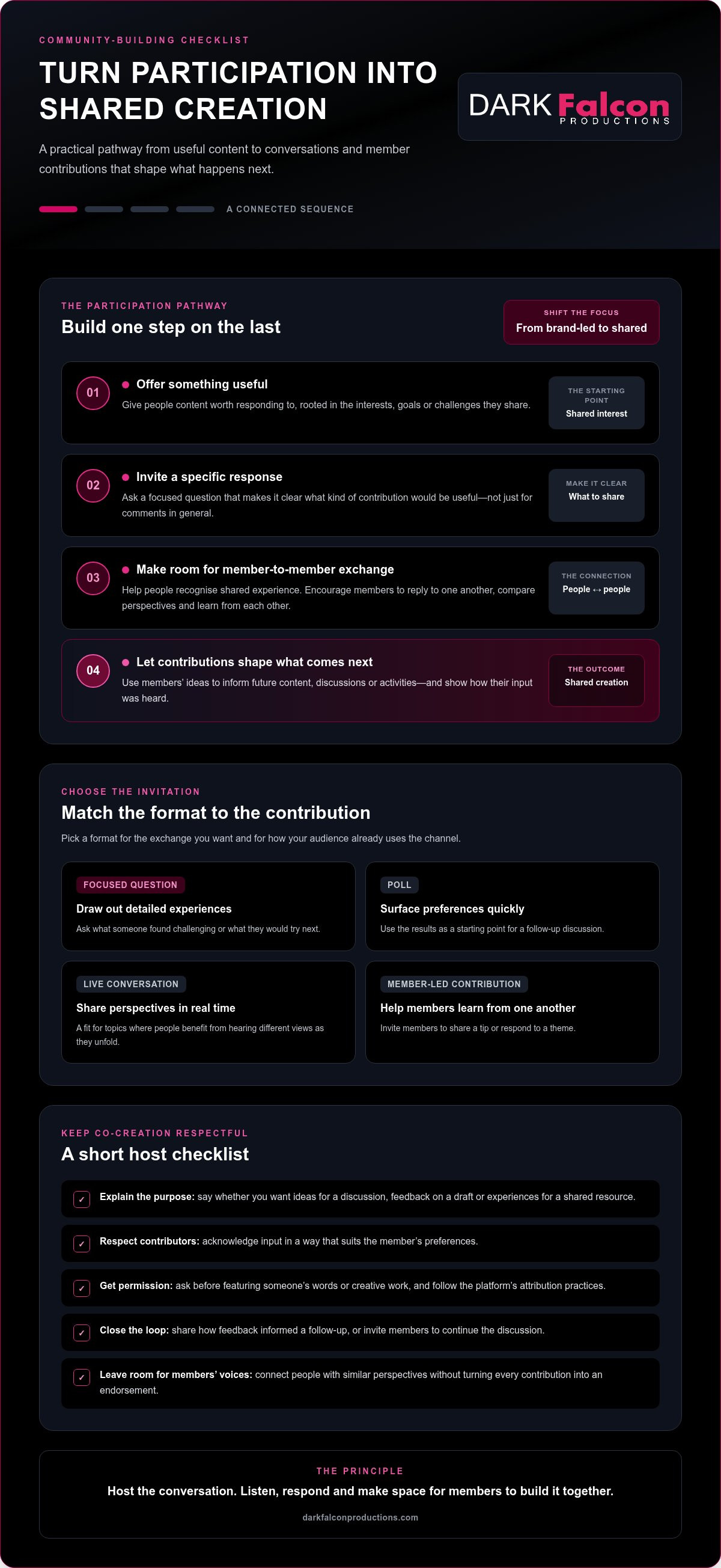
A community develops through a sequence of small, connected actions. Useful content gives people something worth responding to. A thoughtful prompt turns that response into conversation. When members begin replying to one another, they can recognise shared experience. Co-creation follows when their ideas help shape future content, discussions or activities.
Brand-to-audience interaction delivers a message to people; member-to-member interaction gives people a reason to stay and build something together.
That shift takes time. Community-building isn’t a short campaign or a target for how often you post. It’s ongoing relationship work: listen, respond, make space for members, then show that their input has been heard. If people contribute an idea and never see what happens next, participation can feel tokenistic. Close the loop by explaining how feedback informed a follow-up, or inviting members to continue the discussion.
Consistency helps make that invitation familiar. Use recognisable editorial choices, such as recurring discussion themes, a clear tone and visual cues that make participation posts easy to spot. Purposeful short-form video can introduce a topic or show a process, whilst a simple text prompt may give people more room to share their perspective. Choose the format to support the exchange, not overshadow it.
Which social formats invite people to participate?
Choose a format for the contribution you want and for how your audience already uses the channel. A focused question can prompt detailed experiences; a poll can quickly surface preferences, then lead into a follow-up discussion. Live conversations suit topics where people benefit from hearing different perspectives in real time. Member-led contributions, such as sharing a tip or responding to a theme, can help members learn from one another.
Keep the invitation specific. Instead of asking for comments in general, ask what people found challenging or what they would try next. The aim isn’t activity for its own sake. It’s to create a useful exchange that members can join without having to guess what kind of response you expect.
How can a brand encourage co-creation without taking over?
Make the invitation and its purpose clear. Explain whether you’re seeking ideas for a future discussion, feedback on a draft or personal experiences to inform a shared resource. Acknowledge contributions in a way that respects the member’s preferences, and get appropriate permission before featuring someone’s words or creative work. Follow the platform’s practices for attribution, too.
Then leave room for members’ voices. A brand can host the conversation, ask useful follow-up questions and connect people with similar perspectives without turning every contribution into an endorsement. For organisations looking to amplify discussions through authentic creator partnerships, working with an agency like Advocators can help engage messengers who emotionally align with the brand’s shared purpose. Thank participants, share a range of viewpoints and avoid editing their words into a sales message. This balance makes the brand a visible facilitator, not the centre of every exchange.
Building a repeatable rhythm of prompts, responses and member contributions takes deliberate planning. Strategic social media management can help align channel activity and creative content with the community experience you want to create.
How can you tell whether social media engagement is becoming a real community?
Follower growth and reach show how far content travels. Likes and views can indicate that people noticed it. None of these measures, on its own, tells you whether members feel connected or return to take part. To judge how to build a brand community on social media, look for evidence of repeated, reciprocal participation alongside audience-size metrics.
Start by setting a baseline using measures that fit your purpose. Review comparable periods and note what participation looks like now, then look for patterns over time. One unusually active post may reflect a timely topic or a burst of exposure, not a lasting change in relationships. Trends across discussions give you a steadier view.
Which signals show members are connecting with one another?
Track whether people return to contribute, reply directly to other members and share relevant experiences without being prompted to promote the brand. Notice whether a discussion continues after the brand’s initial question, or whether conversation stops when the account stops replying. These behaviours suggest members find value in the exchange itself.
Pair platform analytics with a qualitative review. Read a sample of conversations and note whether members exchange useful advice, build on each other’s ideas or recognise familiar contributors. A comment count can show activity; the substance of those comments helps reveal whether people are forming connections.
Which measures connect community activity to brand objectives?
Keep community health separate from business outcomes. The first reflects participation and relationship quality; the second reflects what the organisation hopes the community may support. Set measures that match the community’s purpose rather than choosing metrics simply because a platform makes them easy to access.
- Community health: repeat contributors, member-to-member replies, useful exchanges and voluntary sharing of experiences.
- Purpose-related activity: participation in a relevant event, feedback that helps shape an initiative or member contributions to a shared resource.
- Business outcomes: qualified enquiries, website visits or retention, where these align with your goals and can be tracked responsibly.
Use the same definitions each time you review results. For example, distinguish a reply to the brand from a reply between members, and record whether discussion started without a direct prompt. This makes comparisons more meaningful and shows where participation is developing, rather than blending every interaction into one engagement figure.
Interpret business measures with care. If enquiries rise during a period of active community participation, that’s a useful relationship to investigate, but it doesn’t prove the community caused the increase. Other activity or wider conditions may also have played a part. Compare trends, consider context and describe the result accurately.
A balanced view makes the next decision clearer. If reach grows but member-to-member replies remain rare, focus on creating better conditions for exchange. If participation is strong but few members take part in relevant activities, review whether those opportunities fit the community’s purpose. For organisations seeking to connect these touchpoints with broader marketing and sales systems, strategic agencies like Stratagon focus on customer-centric campaigns that turn engagement into measurable revenue growth. Measurement should guide refinement, not turn every conversation into a performance target.
How do you build a sustainable social media community step by step?
A community needs a working structure, not a constant stream of posts. Build a repeatable process that connects audience needs to channel choices, day-to-day ownership and regular review. Choose a pace your team can maintain whilst responding thoughtfully to the people taking part.
- Set the purpose. State what members should be able to learn, share or achieve together. Use this as a filter for channel choices and future activity.
- Choose channels with intent. Look at where your audience already takes part and what kind of exchange suits the platform. A short, visual demonstration may work well in a video-led space; a more detailed discussion may need a channel where people can follow replies easily. Prioritise fit over presence everywhere.
- Define the team’s role. Assign responsibility for publishing, monitoring conversations and responding. Agree realistic response expectations that fit your team’s capacity, plus a clear route for escalating sensitive or complex issues.
- Plan recurring activity. Build an editorial rhythm around audience questions and shared interests, balancing useful posts with invitations to participate and follow-up that recognises contributions.
- Set clear participation standards. Explain what respectful, relevant discussion looks like and how moderators will handle spam, harmful comments and criticism.
- Review and refine. Compare participation with your baseline, note what encourages useful exchange and adjust the plan. Keep what serves the purpose; change what feels difficult to sustain or doesn’t invite a meaningful response.
For a more detailed approach to planning posts around audience needs, use this social media content creation strategy guide alongside your community plan. The two should work together: content creates opportunities to participate, while community management helps those opportunities develop into ongoing exchanges.
How should you plan a manageable community rhythm?
Choose a cadence your team can deliver consistently rather than setting an ambitious schedule that leaves no time to respond. Map recurring audience needs to a simple editorial plan: useful content to establish a topic, an open question to invite contributions, then follow-up that reflects what members shared. Decide who checks each channel and when, and who takes ownership if a conversation needs a more considered response.
How can community guidelines make participation safer and clearer?
Make guidelines easy to find wherever the community gathers. Use plain language to describe respectful discussion, relevant contributions and behaviour that isn’t acceptable. Apply the same principles consistently: respond to criticism constructively, manage spam and harmful comments in line with your stated approach, and explain moderation decisions where appropriate. Clear standards help members understand the space and help moderators act with confidence.
A sustainable plan depends on clear strategy as well as well-crafted content. Plan your community’s social media strategy with a coherent approach to channel activity, creative content and ongoing participation.
How can Dark Falcon Productions support a brand community on social media?
A clear community plan sets the direction. Bringing it to life takes connected social strategy, creative content and consistent delivery. Dark Falcon Productions supports this work through strategic social media management and creative production, aligning channel activity with the purpose you want members to share.
The aim isn’t to make every post a sales message. It’s to create relevant ways for people to learn, respond and contribute, then make sure the content and conversations feel like parts of the same experience. That calls for a shared brief and a clear understanding of what the community is there to do.
How can social strategy and creative production work together?
Strategy helps shape the themes, formats and tone of social content. It can guide whether a topic needs a concise prompt, a short-form video that demonstrates an idea, or photography that gives members a clear point to discuss. The creative choice should serve the audience’s needs and intended participation, rather than simply fill a content calendar.
Planned visual content can also give a community continuity. A recurring editorial theme, for example, could invite members to share their approach, with a follow-up video or post reflecting the ideas raised. The brand provides a frame for the exchange; members’ experiences bring it to life. This approach supports a coherent presence without assuming that any particular format will deliver growth or engagement.
What should a productive creative collaboration establish?
Start with a practical brief. Clarify the community purpose, who it is for, which channels suit its behaviour and what members should be able to contribute. Then agree how planning, creative development, production, publishing and conversation management fit together. Clear ownership helps prevent a polished content plan from becoming disconnected from the responses it invites.
It also helps to define the working rhythm: which themes need regular content, what visual assets support them and how the team will carry audience feedback into future activity. Professional video production, editing, short-form content and event photography can support different parts of that experience, from introducing a topic to capturing a shared moment. Select the tools that fit the plan, not every available format.
- Purpose: Set out the shared interest or ambition the community should serve.
- Audience and channels: Identify who you want to reach and where meaningful interaction is most likely to happen.
- Content and participation: Connect creative themes with the contributions you want to invite.
- Ownership: Agree who plans, produces, publishes and responds, including how feedback informs the next stage.
This is where learning how to build a brand community on social media becomes a practical creative process: strategy establishes the intent, whilst content gives people useful ways to take part. Explore social media management and creative production as a considered next step for bringing those elements together.
Make your next step a meaningful one
You don’t need to launch a fully formed community all at once. Choose one audience need, create a clear opportunity for people to contribute, then pay attention to what they share and how they respond to one another. That first exchange can inform the next, giving your community room to grow through genuine participation rather than a bigger posting schedule.
Understanding how to build a brand community on social media is ultimately about making a deliberate commitment: give people a reason to gather, make it easier for them to take part, and keep listening as their needs evolve. Creative strategy and production can help turn that intention into a consistent experience across your social channels.
Ready to shape that experience with a considered plan? Explore strategic social media management and creative production with Dark Falcon Productions, and start with a clear purpose. Every lasting community begins with a conversation worth continuing.
Frequently Asked Questions
Is a brand community the same as having a large social media following?
No. A large following shows that accounts are connected to a profile, but it doesn’t reveal whether people share an interest or interact with each other. For example, hundreds of people might view a product announcement without responding. A smaller group discussing how they use or adapt a product may show stronger signs of community. Look at the quality and continuity of participation, not audience size alone.
Can you build a brand community with a small audience?
Yes. A large audience isn’t necessary to begin. Invite the people already engaging with your posts to contribute something specific, such as a question for a future discussion or a tip that could help others. Then acknowledge useful contributions and make it easy for participants to respond to one another. These early exchanges can show which topics resonate and help you improve the experience before expanding your reach.
How long does it take to build a brand community on social media?
There’s no universal timeline. The pace depends on whether the purpose matters to your audience, how consistently you make space for participation and how much capacity you have to support conversations. Rather than setting an arbitrary deadline, review progress across comparable periods. For instance, note whether contributors return and whether discussion continues without a new prompt. Learning how to build a brand community on social media means allowing relationships to develop over time.
Do you need a separate group to create a social media community?
No. You can begin on an existing brand channel if its features make it practical for people to join discussions and find relevant replies. A separate group may suit members who want a more focused space, such as discussing a particular shared interest away from general announcements. Before creating one, consider who will keep it active and what members will gain from joining. A new space needs a clear purpose, not just another destination.
What should a brand do when community members disagree?
Respond calmly and use clear guidelines to distinguish disagreement from personal attacks, spam or harmful behaviour. For example, if members challenge a recommendation, acknowledge the different views and keep the discussion focused on the issue. Avoid deleting criticism simply because it’s uncomfortable. If a conversation raises a sensitive personal matter, move it to an appropriate private channel where possible, while applying moderation standards consistently.
Does building a social media community require paid advertising?
No. Paid promotion can introduce a community invitation to relevant people, but reach alone won’t give them a reason to participate. First make the invitation specific, such as asking people to share an experience or join a discussion on a defined topic. If you promote it, assess whether the people reached take a relevant next step, not only how many saw it. This helps distinguish useful discovery from exposure without participation.