
In a marketplace saturated with AI-generated noise, professional video is no longer a luxury. It is the only remaining way to signal genuine brand authority and creative gravity to an increasingly sceptical audience. You likely recognise that high-quality storytelling is essential for growth, yet convincing stakeholders on video production investment remains a significant hurdle. When faced with tight budget constraints or questions about non-linear ROI, even the most visionary projects can stall in the boardroom.
It's frustrating to see potential impact sidelined by a fear of creative costs or project disruption. This article provides you with a robust, data-backed framework for internal persuasion to ensure your vision reaches the screen. You'll learn how to bridge the gap between artistic ambition and corporate logic to secure a signed-off budget and total stakeholder alignment. We'll examine how to build a clear roadmap for success, turning your video strategy into a measurable engine for brand prestige and long-term value.
Key Takeaways
- Shift the internal perception of video from a discretionary expense to a strategic necessity by aligning your proposal with the specific objectives of Finance and Operations.
- Implement a rigorous framework for convincing stakeholders on video production investment by focusing on the lifetime value of assets and non-vanity metrics like brand sentiment.
- Leverage the concept of "Creative Gravity" to prove that cinematic quality is a prerequisite for brand authority in an AI-saturated landscape.
- Overcome resistance by reframing high-impact video as a multi-purpose tool that serves several departments, effectively lowering the cost-per-use over time.
- Establish a roadmap for seamless execution that prioritises meticulous pre-production to eliminate the fear of project disruption.
Why Stakeholder Alignment is Critical for Video Success
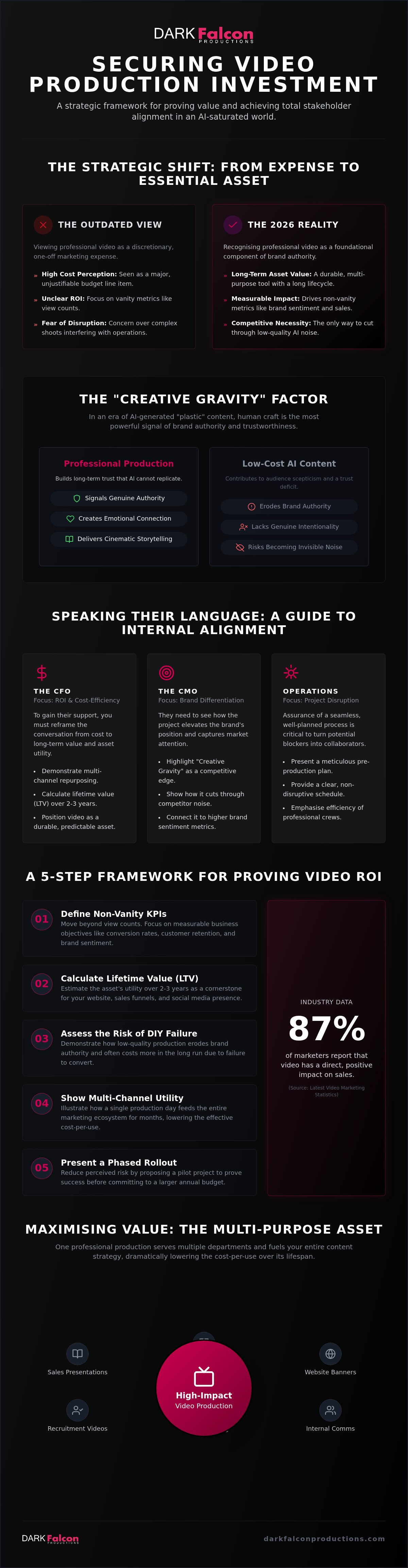
The market has reached a tipping point. By 2026, the sheer volume of digital content has made it nearly impossible for brands to stand out through frequency alone. High-end video production has moved from a discretionary marketing spend to a foundational component of a sophisticated content marketing strategy. Without total alignment across your leadership team, even the most ambitious creative vision will struggle to gain traction.
Securing this alignment requires more than just a creative pitch. It demands a shift in how you frame the project. You aren't just asking for a budget; you're acting as a visionary facilitator who understands the business's broader mission. Succeeding in convincing stakeholders on video production investment means speaking the specific languages of Finance, Operations, and the C-Suite. It's about demonstrating that the cost of inaction is the gradual erosion of brand authority.
Mapping Your Internal Stakeholders
Each gatekeeper views a production through a different lens. The CFO is naturally focused on measurable ROI and cost-efficiency. To win their support, you must demonstrate how a single high-quality asset can be repurposed across multiple channels, extending its lifecycle and lowering the effective cost-per-impression. They value stability and predictable outcomes. Proving that professional video is a durable asset, rather than a fleeting expense, is key to their sign-off.
The CMO, by contrast, seeks brand differentiation. They want to know how the project will elevate the brand's position amongst competitors. Meanwhile, Operations teams often fear project disruption. They need assurance that the production schedule is meticulous and won't interfere with daily workflows. Addressing these concerns early transforms potential blockers into active collaborators who feel invested in the project's success.
The 2026 Context: AI Saturation vs. Human Craft
The rise of low-cost AI video has inadvertently created a trust deficit. Audiences are becoming increasingly sceptical of automated, "plastic" content that lacks emotional depth and genuine intentionality. In this environment, professional production serves as a powerful signal of brand authority. It tells the viewer that the brand is established, reliable, and deeply invested in quality. High-level craft is now the most effective way to cut through the noise.
This is where cinematic brand storytelling becomes a strategic asset. By prioritising human craft, you create "creative gravity." This isn't just about aesthetics; it's about building long-term trust that AI simply cannot replicate. When convincing stakeholders on video production investment, you must position professional video as the primary tool for maintaining this human connection in an automated world. If you don't invest in quality now, your brand risks becoming invisible amongst the commoditised content of the future.
A 5-Step Framework for Proving Video ROI
Proving value requires a shift from viewing video as a one-off expense to seeing it as a long-term strategic asset. When convincing stakeholders on video production investment, you must provide a structured path that mitigates financial anxiety whilst highlighting growth. This framework ensures your proposal is grounded in logic rather than just creative aspiration.
- Step 1: Define non-vanity KPIs. Move beyond view counts. Focus on conversion rates, customer retention, and brand sentiment. According to the latest video marketing statistics, 87% of marketers report that video has a direct, positive impact on sales.
- Step 2: Calculate Lifetime Value (LTV). A high-quality film isn't a single-use item. Estimate its utility over two to three years as a cornerstone of your digital presence.
- Step 3: Assess the risk of DIY failure. Inexpensive, low-quality production often costs more in the long run. It fails to convert and actively erodes the brand authority you've worked to build.
- Step 4: Demonstrate multi-channel utility. Show how one production day feeds your entire marketing ecosystem for months.
- Step 5: Present a phased rollout. Reduce perceived risk by proposing a pilot project. This allows you to prove success before scaling to a larger annual budget.
Beyond the View Count: Meaningful Metrics
High-quality video shortens the B2B sales cycle by establishing trust before a salesperson even picks up the phone. It functions as a 24/7 ambassador that delivers your message with perfect consistency. Our social media content creation services UK guide explores how these assets generate consistent leads by prioritising engagement depth over misleading viral metrics. If you're ready to define your project's specific ROI, a strategic consultation can help map your production goals.
The Efficiency of Multi-Asset Production
One "hero" film can be expertly deconstructed into dozens of social shorts, website headers, and event highlights. Integrating event photography services UK into your schedule ensures visual consistency across all platforms without doubling your logistical efforts. Asset sweat is the process of maximising a single production day to extract the highest possible volume of usable content. This approach turns a single investment into a library of strategic assets that serve multiple departments simultaneously.
The "Gravity" Factor: Cinematic Storytelling as a Competitive Edge
Creative Gravity is the perceived weight and authority of your brand’s visual output. It is the difference between a video that simply conveys information and one that commands respect. When convincing stakeholders on video production investment, you must explain that functional content is now a commodity. AI tools can generate basic explainers in seconds, but they lack the intentionality required to build a prestigious brand. This creates a trust deficit, as audiences can sense when a message has been automated rather than authored. By prioritising human craft, you signal that your organisation values depth over convenience.
High-level stakeholders often respond more powerfully to visionary content than to purely functional assets. This is because The power of storytelling in business lies in its ability to inspire action and emotional resonance. Professional creative video editing services UK play a critical role here. They transform raw footage into a cohesive narrative that reflects the organisation's mission, moving the dialogue from "explaining" a service to "inspiring" a partnership. This transition is essential for securing long-term buy-in from the board.
Aligning Mission with Visual Output
High production values aren't just about vanity. In a B2B context, cinematic precision signals a meticulous approach to business operations. If a brand invests in the integrity of its storytelling, stakeholders naturally assume that same level of care extends to its products and services. This psychological link is vital for building long-term trust amongst sophisticated partners whilst proving that your brand prioritises quality over surface-level marketing. It ensures that every visual asset serves as a testament to your professional standards.
Case Studies in Stakeholder Alignment
We've seen how narrative-driven films can secure investment for even the most complex technical projects. By transforming dry data into a compelling visual journey, you make the business case impossible to ignore. A specialist video production company UK doesn't just provide equipment; they act as a guardian of your brand's gravity. They ensure that every frame serves the strategic vision, making the final output a powerful tool for internal persuasion and external growth.
Navigating the "No": Addressing Common Stakeholder Objections
Resistance is a natural part of the corporate lifecycle. When you encounter pushback, it's rarely a dismissal of the creative vision itself but rather a reflection of perceived risk. Successfully convincing stakeholders on video production investment requires you to pivot from defending an idea to solving a business problem. You must address the logistical and financial anxieties that keep decision-makers awake at night. By anticipating these hurdles, you transform a potential "no" into a collaborative discussion about growth.
The most common objection is cost. Decision-makers often view video as a discretionary, one-off expense. You must reframe this as a long-term strategic asset. A high-quality production provides utility for years, whereas cheap content requires constant, expensive replacement. Similarly, the "no time" argument is usually a fear of internal resource drain. A creative media production partner handles the heavy lifting. They manage the entire lifecycle from development to final delivery, allowing your team to focus on their core duties without distraction.
Objection vs. Strategic Rebuttal
- Budget concerns: Reframe the initial outlay as a multi-year investment. Compare the cost of a single high-impact campaign against the recurring expense of low-performing, "disposable" content.
- Resource concerns: Explain that professional agencies operate as an extension of the team. They reduce the internal workload by providing expert project management and technical execution.
- Quality concerns: Address the "in-house" temptation directly. Whilst internal teams are excellent for quick social updates, they often lack the specialised equipment and cinematic expertise required for high-stakes brand work. Low-quality content is a brand liability that signals a lack of professional gravity.
The "Stealth" Production Workflow
Fear of operational disruption is often the final hurdle. Professional crews don't behave like tourists; they operate like tactical content hunters. They understand that the employee or guest experience is the priority. By using a "stealth" workflow, we capture authentic moments without turning your office or event into a chaotic film set. We prioritise quiet competence and minimal footprints. This methodical approach ensures you get the cinematic content you need without sacrificing daily efficiency or guest comfort. If you are ready to overcome these internal hurdles and start your next project, contact our production team today.
Executing the Vision: From Proposal to Strategic Asset
Once you've succeeded in convincing stakeholders on video production investment, the focus shifts from persuasion to execution. A project only becomes a strategic asset when the initial promise is fulfilled through meticulous development. This begins with a collaborative brief that synthesises the requirements of every department. By aligning marketing’s creative ambition with the logistical constraints of operations, you ensure the production moves forward with total internal support. This document serves as the foundation for the entire project lifecycle, protecting the integrity of the original vision whilst setting clear boundaries for the production team.
Pre-production is the most critical phase for maintaining this alignment. It's during these weeks of development that we identify potential roadblocks and refine the narrative arc. A well-organised pre-production phase removes the fear of project disruption, proving to stakeholders that the investment is being managed with professional gravity. We also integrate social media management into the post-production workflow at this stage. This ensures that every "hero" film is born with a library of short-form assets ready for distribution, maximising the "asset sweat" and utility of the production day. The final edit must reflect a mission-driven purpose, ensuring that the brand’s core values are visible in every frame.
Building the Strategic Brief
The brief acts as the project’s North Star. It's essential to set clear expectations for the first "rough cut" review, as stakeholders unfamiliar with the edit process can find unfinished footage jarring. Managing feedback requires a delicate balance; you must satisfy operational requirements without compromising the creative integrity of the vision. Every decision should be measured against the "Gravity Test": does this frame enhance the brand’s perceived authority? By convincing stakeholders on video production investment through a structured feedback loop, you maintain their confidence from the first shoot through to the final delivery.
Partnering for Long-Term Growth
The most effective production partners don't just operate cameras; they act as visionary guides through the entire lifecycle. They understand that a cinematic highlight film is only useful if it aligns with your broader business objectives. Whether you are filming at a single site or require national coverage for multi-site corporate projects across the UK, your partner must maintain a consistent standard of excellence. This steady hand ensures that your video efforts can scale alongside your business objectives, turning a single project into a long-term growth engine. Organise a consultation with Dark Falcon Productions to build your business case.
Securing Your Brand's Visual Future
Transforming video from a discretionary spend into a pillar of brand authority requires a blend of corporate logic and creative ambition. By focusing on non-vanity metrics and the long-term utility of high-quality assets, you move beyond the "nice-to-have" stigma that often stalls production. Successfully convincing stakeholders on video production investment depends on your ability to prove that cinematic quality is the only way to maintain trust in an automated market. You aren't just buying a film; you're investing in a library of strategic assets that serve your entire organisation.
Dark Falcon Productions acts as a visionary guide for brands looking to establish true creative gravity. We provide national UK coverage with a boutique, mission-driven approach, ensuring every production aligns with your high-level business goals. Our expertise in cinematic brand storytelling and high-impact event production helps you bridge the gap between artistic vision and logistical duty. When you prioritise depth and intentionality, your brand becomes impossible to ignore.
Partner with Dark Falcon Productions to craft your next visionary project. Your mission deserves to be seen with the weight and clarity it carries.
Frequently Asked Questions
How do I calculate the ROI of a brand-building video?
ROI calculation involves tracking lead quality and the shortening of the sales cycle. Instead of focusing on raw views, measure how video content influences brand sentiment and customer retention over a three-year period. This data-backed approach is central to convincing stakeholders on video production investment. By demonstrating that a single cinematic asset serves as a 24/7 brand ambassador, you prove its value as a durable revenue driver rather than a fleeting marketing cost.
What is the most common reason stakeholders reject video production budgets?
Budgets are typically rejected due to a perceived lack of immediate, linear ROI or a fear of high creative costs. Many decision-makers view video as a discretionary expense rather than a foundational strategic necessity. To overcome this, you must reframe the production as a multi-use asset that serves several departments. Highlighting the "asset sweat" potential helps stakeholders see the project as a cost-efficient way to achieve long-term brand visibility across the UK.
Can I use AI to reduce the cost of professional video production?
Whilst AI can assist with logistical planning or basic transcripts, it cannot replicate the emotional depth of cinematic storytelling. Sophisticated audiences in 2026 can identify automated content, which can lead to a trust deficit. Professional production signals brand authority and "creative gravity" that AI simply lacks. Using AI as a supplementary tool is fine, but human-led creative direction remains the primary signal of a high-level, reliable brand that values craftsmanship.
How long does it typically take to go from stakeholder approval to a finished film?
The lifecycle from approval to final delivery typically takes between four and eight weeks. This timeframe allows for a meticulous development phase where the strategic brief is finalised. Following the shoot, the professional video editing process ensures the narrative is polished and aligned with your mission. Rushing this sequence often compromises the quality and authority of the final output, so a structured production workflow is essential for achieving the desired strategic impact.
Will a professional video crew disrupt our daily business operations?
A professional crew operates with a tactical, minimal-footprint approach to ensure your daily operations remain the priority. We use a "stealth" workflow that avoids the chaotic atmosphere of a traditional film set. This method allows us to capture authentic moments and cinematic event highlights whilst respecting the guest or employee experience. You get the high-impact visual assets you need without sacrificing the efficiency or comfort of your live business environment.
How many social media assets can I expect from a single day of filming?
A single day of filming can generate a primary "hero" film and more than 20 social media shorts. By integrating social media management into the post-production phase, we ensure your content is optimised for various platforms. This approach maximises the utility of your investment and provides your marketing team with a consistent library of assets for months. It turns a one-off production day into a comprehensive engine for ongoing digital engagement.
Why is creative direction more important than the technical equipment used?
Technical equipment is merely a tool; creative direction is what provides the brand's "gravity." Anyone can rent a high-end camera, but only an expert director can align visual storytelling with a specific business mission. Creative direction ensures that the final edit inspires action and commands respect from a sophisticated audience. It is this intentionality that builds long-term trust and differentiates your brand from the commoditised, functional content typically found in the market.
What should I include in a video production proposal for my board?
Your proposal should include non-vanity KPIs, a multi-channel distribution plan, and a clear roadmap for measuring success. It must address logistical concerns by detailing a "stealth" production workflow to mitigate fears of disruption. This structured approach is vital for convincing stakeholders on video production investment. By proving that the production is a strategic asset with a three-year utility, you provide the board with the confidence they need to sign off the budget.