
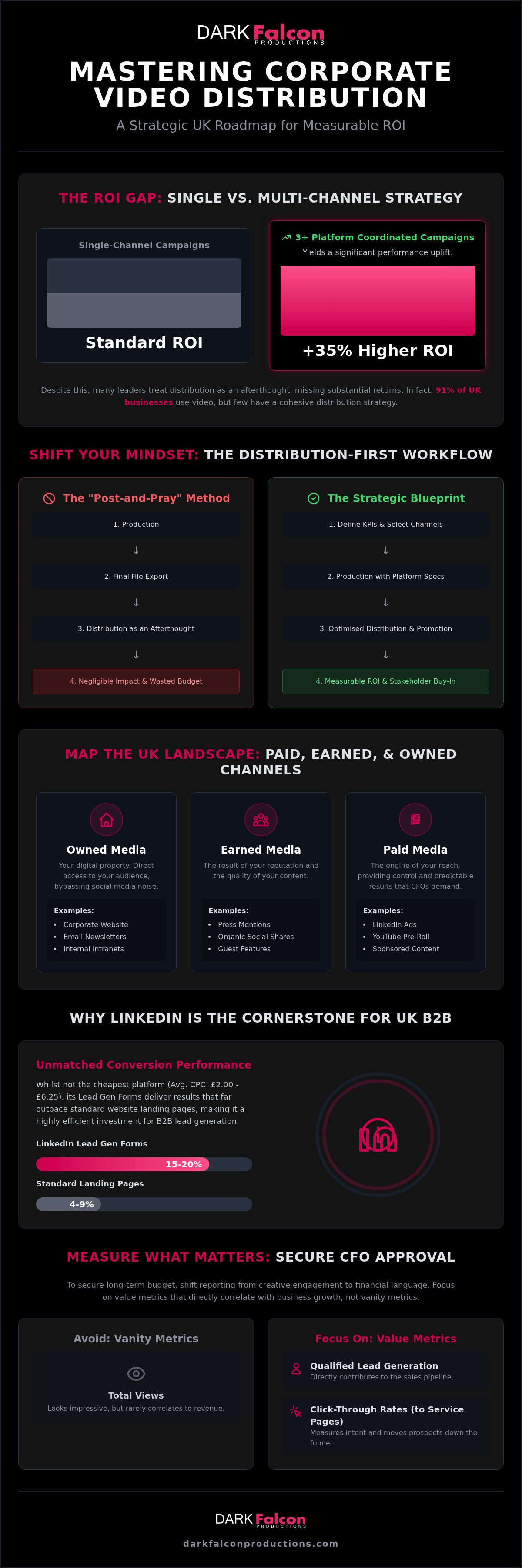
Did you know that UK advertisers running coordinated campaigns across three or more platforms see a 35% higher ROI than those sticking to a single channel? Despite this, many leaders still treat distribution as an afterthought. You've likely felt the pressure of justifying high production costs whilst struggling to prove how a single film impacts the bottom line. It's a common frustration when 91% of UK businesses now use video, yet few have a cohesive corporate video distribution strategy UK stakeholders can trust for consistent results.
We understand that creative ambition shouldn't be stifled by a lack of data. This guide will help you master the art of securing budget approval by aligning your video output with measurable business outcomes and strategic channel selection. You'll learn how to navigate the 2026 Media Act regulations, leverage LinkedIn's 15-20% conversion rates, and build a repeatable roadmap that turns creative vision into a corporate asset. We'll examine the specific frameworks needed to ensure your content is properly optimised for multiple platforms, ensuring your next project delivers a clear, strategic return.
Key Takeaways
- Learn how to move beyond "post-and-pray" tactics by aligning every video project with specific corporate KPIs and measurable business outcomes.
- Identify the optimal mix of paid, earned, and owned channels to ensure your message reaches the right UK B2B decision-makers at the correct stage of their journey.
- Discover why LinkedIn remains the cornerstone of a corporate video distribution strategy UK leaders approve, whilst exploring how to leverage the rise of short-form content in professional spaces.
- Build a multi-channel roadmap that transforms "Hero" content into a library of micro-assets to maximise the value of your production budget and extend content longevity.
- Develop a reporting framework that translates creative engagement into the financial language required to secure long-term stakeholder buy-in and CFO-level budget sign-off.
Aligning Video Distribution with UK Corporate Objectives
In the sophisticated UK B2B environment, simply uploading a video to a company page is no longer sufficient. Corporate video distribution is the intentional, data-led placement of content across specific channels to meet defined Key Performance Indicators (KPIs). A "post-and-pray" approach often results in high production costs with negligible impact on revenue. Strategic distribution is the bridge between creative vision and commercial reality.
Securing stakeholder buy-in requires a shift in perspective. Decision-makers are rarely moved by creative flair alone; they require proof of utility. By defining the distribution path before production begins, you demonstrate a commitment to commercial results. This alignment ensures that every pound spent on production is an investment in a specific business outcome rather than a speculative creative exercise.
The "Distribution First" Planning Mindset
Waiting until the final file is exported to think about distribution is a costly mistake. Successful leaders reverse the workflow, selecting their primary channels before the first day of filming. This foresight ensures that the production team captures the right aspect ratios, durations, and messaging hooks required for each platform. Distribution is not the final step. It is the strategic blueprint.
These requirements directly dictate the technical specifications of professional video editing services. For instance, a cinematic interview for a corporate website requires a different editorial rhythm and framing than a vertical cut designed for LinkedIn. Every piece of content must have a "Core Audience Action" identified at the outset. If you don't know what you want the viewer to do after watching, the video has no place in your corporate video distribution strategy UK.
Setting Measurable UK-Centric KPIs
Securing budget approval in 2026 requires moving beyond vanity metrics. Whilst total views might look impressive on a slide deck, they rarely correlate with bottom-line growth. Instead, focus on value metrics such as qualified lead generation, click-through rates to specific service pages, or internal engagement scores for employee communications. These objectives should align with foundational content marketing principles, ensuring that video acts as a functional cog in the wider business machine.
By benchmarking against UK industry standards, you can prove the efficacy of your strategy to stakeholders. This analytical rigour ensures that your output supports the broader cinematic brand storytelling mission whilst delivering the tangible results the board expects. High-quality execution must be matched by high-quality measurement to sustain long-term investment.
Mapping the UK Landscape: Paid, Earned, and Owned Channels
A resilient distribution framework splits the landscape into three distinct territories: owned, earned, and paid media. Owned channels are your digital property. Earned channels are the result of your reputation. Paid channels are the engines of your reach. Balancing these is a core component of a modern corporate video distribution strategy UK leaders must master to justify investment. In the 2026 market, a single-channel approach is a liability; success lies in the synergy between these three pillars.
Owned media starts with your corporate website. It should be the definitive hub for your storytelling. According to official UK social media statistics, internet usage amongst UK adults is near-total, making your site a critical touchpoint. Beyond the website, your email lists and internal intranets allow you to reach stakeholders directly. This direct access bypasses the noise of public social feeds and ensures your message lands with those already invested in your brand.
Paid media provides the control that CFOs demand. In the UK, LinkedIn remains the undisputed leader for B2B engagement. With an average CPC of £2.00 to £6.25, it's not the cheapest platform, yet its Lead Gen Forms boast conversion rates of 15-20%. This far outpaces the 4-9% typically seen on standard landing pages. YouTube offers massive scale, reaching 94% of UK adult internet users, making it ideal for pre-roll brand awareness campaigns that build long-term gravity.
If you need to ensure your content reaches the right desks, we can help organise your distribution roadmap to align with your commercial goals.
The Power of Owned Media for B2B
Your website should do more than host video files. It must use content to solve specific user problems. Strategic placement on service pages can significantly reduce bounce rates and increase dwell time. It provides a visual shorthand for complex solutions that text alone cannot match. Integrating video into direct email outreach also humanises the sales cycle, providing a steady hand in an increasingly automated digital world.
Paid Distribution: Precision Targeting in the UK
Precision is the hallmark of a professional corporate video distribution strategy UK. LinkedIn allows for surgical targeting by job title, seniority, and UK company size. Conversely, YouTube's "Find My Audience" tools allow you to identify specific UK market segments based on intent and behaviour. Budgeting should account for "Always-On" content to maintain brand gravity, alongside "Campaign-Based" bursts for specific product launches or events.
Comparing Platform Performance for UK B2B vs B2C
Understanding the distinction between B2B and B2C engagement is vital for any corporate video distribution strategy UK marketers design. Whilst B2C audiences often seek entertainment or immediate gratification, the UK professional mindset is driven by utility, efficiency, and peer validation. Professionals don't just consume content; they evaluate its relevance to their specific industry challenges. This requires a shift from broad-reach tactics to precision-targeted delivery across platforms where decision-makers already congregate.
We've seen a notable rise in short-form video within corporate environments. TikTok for Business UK is no longer just for consumer brands; it's becoming a viable space for thought leadership and behind-the-scenes glimpses of corporate culture. However, high-end commercial video production requires platform-specific tailoring to remain effective. A cinematic brand film might thrive on a homepage, but it needs a punchy, subtitle-heavy edit to capture attention on a fast-moving social feed. Success depends on respecting the context of the viewer's environment.
LinkedIn: The Professional Standard
LinkedIn remains the primary arena for UK corporate engagement. To maximise reach, always favour native video uploads over external links, as the platform's algorithm prioritises content that keeps users on-site. Given the prevalence of open-plan offices in the UK, "Sound-Off" optimisation is non-negotiable. If your video doesn't communicate its core message through captions and visual cues within the first three seconds, you'll lose the viewer. Encouraging employee advocacy is another powerful lever; when a team member shares a video, it carries significantly more weight amongst their UK peers than a corporate post alone.
YouTube and Beyond: Search vs Discovery
YouTube serves a dual purpose as both a discovery engine and a powerful search tool. Optimising your content with UK-specific keywords ensures your videos appear when prospects search for solutions to their business problems. For more sensitive or bespoke communications, "Unlisted" videos are an excellent tool for sending tailored presentations directly to high-value clients. Beyond the major platforms, don't overlook the influence of industry-specific newsletters and UK trade associations. These niche channels often provide higher engagement rates because the audience is already pre-qualified and searching for expert insights within their specific sector.
Creating the Multi-Channel Distribution Roadmap
The transition from a single production to a long-term commercial asset happens during the roadmap phase. A successful corporate video distribution strategy UK requires a methodical execution plan that extends far beyond the initial launch date. You should begin by auditing your existing UK audience touchpoints. This involves mapping out every digital and physical space where your brand interacts with prospects, from the corporate website to LinkedIn groups and industry trade shows. This audit ensures you don't waste resources on platforms where your specific audience doesn't reside.
Once the landscape is clear, you must define your "Hero" content. This is your flagship film, the high-production piece that carries the weight of your brand's mission. However, a single film is not a strategy. You must extract "Micro-Assets" from this core piece to maintain a consistent presence over a 6-month period. To achieve this level of precision, you should organise your internal team or a creative media production partner who understands the logistics of multi-channel delivery. A steady hand in the production phase ensures the rollout remains purposeful and polished.
Asset Repurposing and Variation
One high-quality film can be transformed into 15 or more social media assets. This isn't just about cutting a long video into shorter clips; it requires professional video editing that maintains quality whilst tailoring the narrative "Hook" for different UK audience segments. A procurement officer needs a different entry point than a CEO. By varying the opening seconds and call-to-action for each micro-asset, you ensure the content feels bespoke to the platform it lives on. This approach maximises your initial investment and prevents your message from becoming stagnant.
The Distribution Calendar
A 6-month rollout prevents content fatigue amongst your core UK followers. You must plan your schedule around the UK financial year and major industry events to ensure your message arrives when budgets are being allocated or when professional interest is at its peak. Automation tools can help manage the heavy lifting of scheduling, but you must maintain a "Human-First" brand voice to inspire trust. If you're ready to move beyond fragmented uploads, we can design your bespoke distribution roadmap to ensure your content delivers long-term commercial value.
Measuring ROI and Securing Long-Term Stakeholder Buy-In
Measuring success is the final pillar of a corporate video distribution strategy UK stakeholders can respect. CFOs and board members aren't impressed by millions of views if those views don't translate into qualified leads or shortened sales cycles. To secure long-term buy-in, you must build a reporting dashboard that speaks the language of finance. This involves attributing revenue to specific video touchpoints throughout the UK buyer journey. When you can prove that a series of micro-assets directly influenced a high-value contract, the conversation shifts from "cost" to "investment."
A strategic partner plays a vital role in this process. They don't just deliver the final edit; they provide the post-production analytics needed to refine future campaigns. This data-led approach ensures that your distribution roadmap evolves alongside your audience's behaviour. By demonstrating a clear link between content and commercial outcomes, you pave the way for larger budgets and more ambitious creative projects in the future. It's about showing that your creative output is a functional tool for business growth.
The Metrics That Matter to the Board
You should shift your focus from Cost Per View (CPV) to Cost Per Lead (CPL). In the UK B2B sector, a view is often a vanity metric unless it triggers a measurable action. Video completion rates serve as a far more potent proxy for brand authority and trust. If a prospect watches 80% of a technical explainer, they're demonstrating high intent and deep engagement with your expertise. Don't overlook qualitative feedback from your sales team. If they report that prospects are referencing specific video content during discovery calls, you have tangible proof of impact that raw numbers cannot capture.
Presenting the Results for Renewal
When the time comes for budget renewal, present a "Value Report" instead of a mere "Performance Report." Focus on how the content solved specific business problems rather than just listing engagement stats. You can use success stories from the current campaign to justify bespoke event production services for the next quarter. This narrative approach allows you to plan the next phase of your UK distribution evolution with confidence. By showing the board that you understand the commercial reality of production, you transform from a service requester into a visionary partner who understands the bottom line.
Securing the Future of Your Corporate Narrative
A successful project doesn't end when the cameras stop rolling. It begins with a meticulous corporate video distribution strategy UK leaders can rely on for measurable growth. By aligning your creative output with specific commercial KPIs and mapping a multi-channel roadmap, you transform video from a discretionary expense into a core business asset. You've seen how precision targeting on LinkedIn and strategic asset repurposing can extend the lifecycle of your content whilst satisfying the analytical requirements of the board.
Expertise in high-impact corporate video and social management is essential for navigating the 2026 landscape. As a visionary partner for strategic UK brands, we bring meticulous attention to professional gravity and craftsmanship to every stage of the process. We help you move beyond fragmented uploads towards a cohesive, results-driven framework that inspires confidence in your stakeholders.
Ready to elevate your brand's presence? Partner with Dark Falcon Productions to organise your 2026 distribution strategy and ensure your next campaign delivers the commercial impact it deserves. The path to budget approval is paved with data, strategy, and high-quality execution.
Frequently Asked Questions
How much should we budget for corporate video distribution in the UK?
Budgeting for distribution should ideally match or exceed the production cost to ensure your content reaches the intended audience. In 2026, many UK firms allocate between 30% and 50% of their total project budget specifically to paid promotion and strategic placement. This investment covers LinkedIn advertising, YouTube pre-roll, and programmatic buys. Without a dedicated distribution fund, even the most cinematic brand film risks becoming a ghost asset that fails to deliver a commercial return.
What is the best platform for B2B video distribution in 2026?
LinkedIn remains the undisputed leader for B2B engagement in the UK, offering precise targeting by job title and company size. Whilst other platforms are growing, LinkedIn's Lead Gen Forms provide conversion rates between 15% and 20%, which is significantly higher than standard landing pages. A robust corporate video distribution strategy UK often centres on LinkedIn as the primary touchpoint for reaching senior decision-makers whilst they are in a professional and receptive mindset.
Should we use a third-party agency for video distribution or keep it in-house?
The choice depends on your internal capacity for data analysis and platform management. Whilst in-house teams understand the brand's nuances, a strategic partner like Dark Falcon Productions provides the technical expertise required for multi-channel optimisation. We help organise the distribution roadmap and provide post-production analytics that internal teams often lack the tools to track. Specialist agencies ensure that professional video editing and social media management work in tandem to maximise your ROI.
How do we ensure our corporate video complies with UK GDPR regulations?
Compliance involves securing explicit consent from every individual appearing in your footage through signed talent release forms. You must also ensure that any data captured via video engagement tools or lead forms is stored and processed according to current UK data protection laws. Working with a professional production partner ensures that these logistical requirements are handled during the pre-production phase, protecting your brand from the legal risks associated with unauthorised image usage or data breaches.
What is the ideal length for a corporate video on LinkedIn?
For organic feed posts, videos between 30 and 90 seconds typically see the highest completion rates. If you're running a paid Lead Gen campaign, shorter micro-assets under 30 seconds often perform better as they respect the viewer's time whilst delivering a punchy call-to-action. Longer films are better suited for your corporate website or YouTube channel where users have a higher intent to learn. Always prioritise subtitle optimisation, as most UK professionals watch content without sound.
How do we measure the ROI of a video that is purely for brand awareness?
Brand awareness should be measured through value metrics such as uplift in branded search traffic and improved video completion rates. Instead of looking for immediate sales, track how awareness content influences the cost per lead in later stages of the funnel. If your awareness films are well-distributed, you'll often see a 25% to 35% higher ROI on coordinated campaigns across multiple platforms. Qualitative feedback from your UK sales team also provides vital evidence of brand trust.
Can we repurpose event footage for our social media distribution strategy?
Repurposing event footage is a highly efficient way to maintain content momentum throughout the year. High-quality event photography and video can be edited into short-form "Shorts" or industry-specific teasers that keep your brand visible between major projects. This approach ensures your corporate video distribution strategy UK remains "Always-On" without requiring a full-scale production for every social update. It's about maximising the lifecycle of every asset captured during your national UK events and exhibitions.
How often should we update our video distribution roadmap?
You should review your distribution roadmap at least every quarter to account for shifts in platform algorithms and audience behaviour. Major updates are often required annually to align with the UK financial year and new budget cycles. Regular audits allow you to pivot your strategy based on the performance data gathered in previous months. This methodical approach ensures that your distribution remains purposeful and continues to meet the evolving KPIs set by your senior stakeholders.