
Video budget approval is won in the business case, not the shot list. If you’re working out how to get budget approval for video marketing, start with the business problem the investment will address, not the creative concept you’d like to produce.
Decision-makers may see video as a discretionary expense, particularly when they expect immediate returns that are easy to attribute. An unclear scope makes the decision harder. Connect the intended audience, channel and content to a business priority, then set out realistic measures of progress without promising more than the plan can deliver.
This guide will help you build a concise, evidence-led proposal that explains the need, investment, delivery plan and success measures. You’ll learn how to define the project scope, account for both production and distribution, and show how video could support wider marketing activity. The aim is to make the decision clear, or identify a practical next step towards one.
Key Takeaways
- Learn how to get budget approval for video marketing by presenting a clear business case rather than a production wishlist.
- Use relevant campaign evidence to support your proposal, and label assumptions so decision-makers can assess them fairly.
- Compare possible video approaches against the same objective, audience and measurement criteria, not production scale alone.
- Make your request easy to act on by stating the decision needed and keeping supporting detail available.
- Turn an approved budget into a purposeful brief that aligns production, editing and social content with the intended outcome.
How to get budget approval for video marketing: start with the business need
Video budget approval is a decision about business value, project scope and the resources required to deliver it. It isn’t simply permission to make a film. Decision-makers need to understand what organisational need the work addresses, who it is for and what the investment is intended to support. For small and mid-sized B2B companies looking for experienced marketing leadership to articulate that commercial value, fractional CMO services from budgetboosters.eu can help align campaign initiatives with overarching business goals.
Keep the problem separate from the creative execution. “We need a brand film” describes a possible output. “Prospective customers don’t understand how our service works before speaking to sales” identifies a communication problem. Video may help explain a complex offer, but consider it in the context of the audience’s needs and the channels available to reach them.
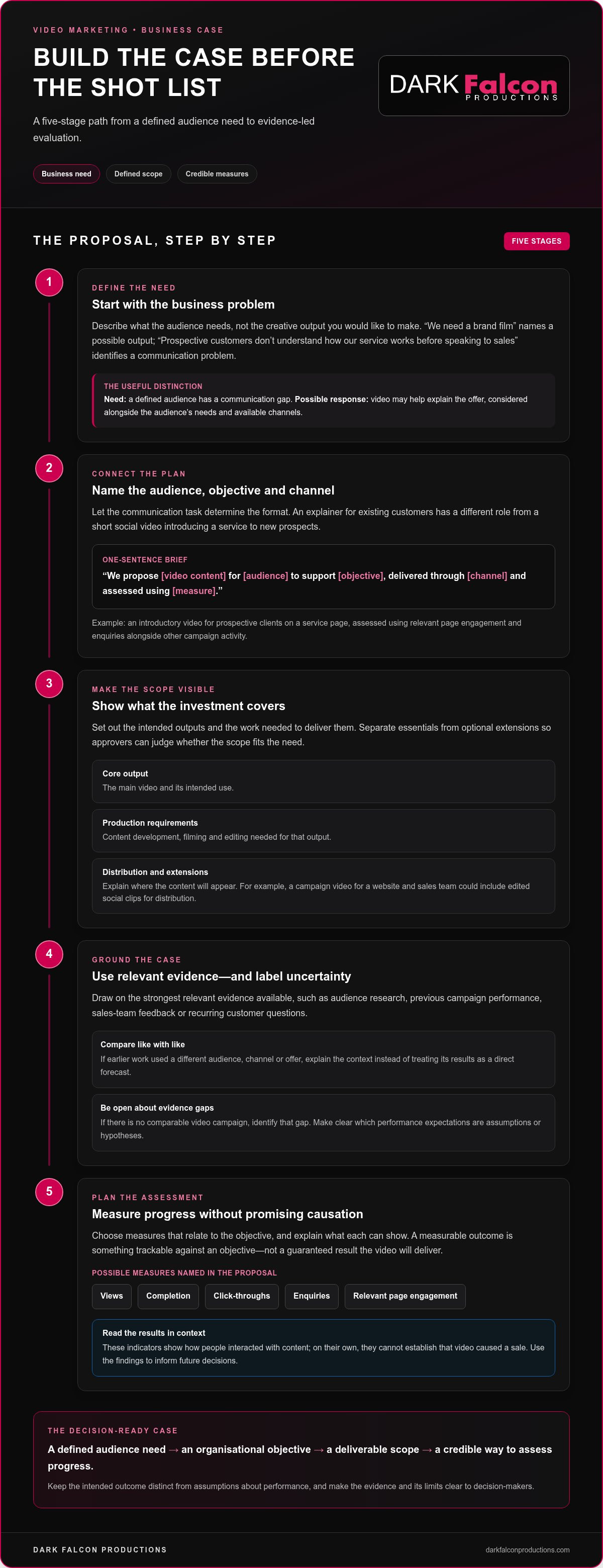
A strong video marketing business case connects a defined audience need to an organisational objective, a deliverable scope and a credible way to assess progress.
What decision-makers need to understand before approving video
State the audience, need and intended change in plain business language. For example: “New customers need a clearer introduction to the onboarding process, so we propose a short explainer for the help centre.” This gives approvers a reason to consider video without claiming it will automatically reduce support requests or improve retention.
Separate the desired outcome from assumptions about performance. The outcome might be improved understanding; the assumption is that a video will achieve it. Explain why video suits the task, such as showing a sequence visually or delivering the same explanation consistently across channels. Identify how you could assess whether the communication is working, and label any untested performance expectation as a hypothesis.
Turn a creative idea into an organisational objective
Translate the idea into a specific objective, such as raising awareness of a new service or helping a defined audience understand a complex process. Name the audience and where the content will reach them, whether that is a website, a sales presentation or social channels. Let the communication task determine the format, rather than choosing a format first and looking for a reason to make it.
Connect the proposal to the wider marketing plan. An explainer for existing customers has a different role from a short social video introducing a service to new prospects. The objective, audience and channel shape what needs to be produced, how it will be used and what evidence will be relevant afterwards.
Before requesting approval, write a one-sentence brief that completes this thought: “We propose [video content] for [audience] to support [objective], delivered through [channel] and assessed using [measure].” For instance, a professional services firm might propose an introductory video for prospective clients on a service page, then review relevant page engagement and enquiries alongside other campaign activity. Those measures can inform evaluation, but they don’t prove the video alone caused a change.
For a broader view of how a production project can take shape, the UK video production company guide offers useful context. At the approval stage, keep the focus on why this audience needs the message and how a defined piece of video content could meet that need.
Build the video marketing business case around scope, outcomes and evidence
A persuasive proposal presents the work and its intended impact together. Decision-makers should be able to see what will be made, who it is for, where it will appear and how the team will assess its contribution. If one of these elements is missing, it becomes harder to judge whether the scope fits the need and whether the measures match the objective.
For example, a company launching a new service might propose a campaign video for its website and sales team, with edited social clips for distribution. The case should explain the intended audience, the role of each output and the measures to be reviewed, such as relevant page engagement or enquiries. These indicators show how people interacted with the content; on their own, they can’t establish that video caused a sale.
A measurable outcome is a result you can track against an objective, not a guaranteed result the video will deliver.
Choose evidence that supports the proposal
Use the strongest relevant evidence available: audience research, performance from previous campaigns, sales-team feedback or recurring customer questions. Compare like with like where possible. If an earlier campaign used a different audience, channel or offer, explain that context rather than presenting its results as a direct forecast. This helps approvers see what the evidence supports and where judgement is still required.
Evidence can help shape the proposal, but it shouldn’t disguise uncertainty. If there’s no comparable video campaign, identify the gap and make the first project a learning opportunity. Set out what you’ll record, such as views, completion, click-throughs or enquiries, and how each measure relates to the objective. Label forecasts as assumptions, then use the results to inform future decisions.
Define deliverables and boundaries before discussing investment
Describe the intended outputs and the work needed to deliver them. Separate essential items from optional extensions so decision-makers can see what the core proposal covers. A defined scope also keeps production choices, distribution and measurement connected to the same business purpose.
- Core output: the main video and its intended use.
- Production requirements: the content development, filming and editing needed for that output.
- Distribution: the planned channels and any separate activity needed to reach the audience.
- Optional extensions: additional edits or social clips that could be considered separately.
Be clear about boundaries too. State what the proposed project includes and what would require a separate decision, such as extra versions, channels or rounds of content. This prevents an ambitious creative idea from quietly expanding beyond the approval being sought. Creative content development can help shape the work around a considered brief and its intended use.
Make evidence, scope and measurement reinforce one another. A creative production partner can turn those priorities into a defined project brief through video production and editing.
Compare video marketing options without reducing the decision to cost
Put the options side by side against the same business need. A comparison based only on production scale can make a larger package look more ambitious, or a smaller one look safer, without showing which better suits the audience and task. Use consistent criteria so decision-makers can weigh purpose, delivery and learning alongside investment.
For example, if the need is to help prospective clients understand a technical service, compare a detailed explainer with a focused set of short videos and a broader content plan. Each option should address that same need, rather than using a different objective to make one format appear stronger.
| Option | Objective and audience | Scope and distribution | Measurement |
|---|---|---|---|
| Focused explainer | Clarify the service for prospective clients researching it. | One core video on a relevant website page, with use in sales conversations. | Review page engagement and related enquiries, while noting other influences. |
| Short-form pilot | Test which parts of the service need clearer explanation for social audiences. | A small set of concise edits distributed through selected social channels. | Compare viewing and interaction signals, then gather audience or sales-team feedback. |
| Broader content plan | Support understanding at several stages of the prospective client journey. | A planned sequence of video outputs for relevant web, social and sales use. | Review channel-specific indicators alongside enquiries and qualitative feedback. |
Compare formats by purpose and intended use
The table is a decision aid, not a performance forecast. Match each format to the message, the audience’s familiarity with it and the channel where they will encounter it. A detailed explainer may suit a service page; short edits may make one concept easier to introduce on social media. Neither format is best in every context. Explain in the brief why each option fits its intended use.
Account for distribution as well. A video intended for a website may need a different structure from content planned for social feeds or sales presentations. Show where each version will appear and how it supports the same objective. This gives approvers a fuller view of the proposed activity without treating production as the whole plan.
Assess risk, learning value and measurement limits
A focused pilot can limit the initial commitment and reveal whether the message, format or channel merits further development. A broader plan can provide connected content for multiple audience needs, but it may involve more assumptions before results are available. Make the trade-off explicit. Neither approach is automatically the right choice.
List assumptions that could affect delivery or interpretation, such as audience reach, distribution support or the availability of baseline data. Agree what the pilot should teach and what evidence would inform a next step. Views or clicks can indicate exposure and interaction, but they can’t prove that video alone caused an enquiry or sale when other channels also shaped the decision. Clear attribution limits make the case more credible. For how to get budget approval for video marketing, compare options by the business question they can help answer, not by cost or production scale alone.
Present a video marketing budget request decision-makers can act on
A clear proposal makes the decision easy to find. Open with the business need, then set out the objective, audience, scope and measures. Close by stating exactly what approval you’re seeking. Keep the recommendation concise, with detailed evidence and working assumptions available as supporting material rather than crowding the main case.
This gives stakeholders a practical way to assess the request: does the work address a priority, is the scope understandable, and can progress be reviewed? It also keeps the discussion centred on the decision instead of letting it drift into a debate about creative preferences.
What to include in a concise approval proposal
Use clear sections so finance and leadership can quickly find the information they need. Begin with the need and intended audience before describing the creative execution. Then define what the project will deliver, where the content will be used and who will own each part of delivery.
- Need and objective: State the organisational priority and the communication task the video is intended to support.
- Audience and distribution: Identify who the content is for and the channels through which it will reach them.
- Scope and ownership: Describe the planned outputs, key responsibilities and any dependencies.
- Measures and review: Name the indicators you’ll monitor and when you’ll report on learning.
- Decision required: Specify whether you’re seeking approval for a defined project, a pilot or a next planning step.
Make assumptions visible. For example, note if the plan depends on an existing channel, access to customer insight or another team’s contribution. This helps approvers distinguish what’s within the project’s control from what relies on wider organisational support. Keep optional elements separate from essential deliverables so the requested decision has a clear boundary.
Prepare for questions from finance and leadership
Expect questions about competing priorities, uncertain outcomes and attribution. Respond by showing how the proposal supports an agreed objective, what evidence informs the scope and where the limits of that evidence lie. If several channels contribute to an enquiry, don’t claim that video alone caused it. Explain which indicators will be reviewed and how they’ll be interpreted alongside other activity.
If asked for a guaranteed return, be direct: the proposal can define what the team will measure, but it can’t promise a specific result without a reliable basis. Offer a review point based on learning, such as assessing whether the intended audience engaged with the content and whether the message addressed the communication need. That review can inform whether to refine, extend or pause the activity.
A useful meeting summary is: “We’re seeking approval for this defined scope, for this audience and objective. The delivery owner is [role], and we’ll return with the agreed measures and learning at [review point].” This gives stakeholders a concrete decision while making accountability clear. It’s a practical part of how to get budget approval for video marketing, particularly when leaders need a credible plan rather than a promise of certainty.
A clear production brief should carry the agreed objective into delivery. Dark Falcon Productions provides video production services to support that work.
Move from approved video marketing budget to a purposeful production plan
Approval sets the direction. The next task is to carry that decision into production without losing sight of why the work was funded. A clear brief gives the creative team a shared reference point: the audience, objective and agreed measures should shape the content, rather than being added after filming or editing has begun.
This handover also helps keep the approved scope intact. If the brief introduces new audiences, channels or deliverables, treat them as changes to discuss rather than quietly expanding the project. A considered production plan makes responsibilities visible and lets stakeholders follow progress from development through delivery and review.
Translate the approved case into a production brief
Bring the decision into a working document that creative and marketing teams can use. Include the audience insight, communication objective and measures agreed during approval. Then describe the intended outputs, channels, responsibilities and review points. This lets creative choices serve the approved need. For instance, a video intended to explain a service to prospective clients should make that explanation central, whether the plan includes a main film, edited versions or social content.
Clarify who provides subject expertise, who approves the messaging and who signs off the finished content. Agreeing these roles early helps prevent avoidable delays and keeps feedback focused on the brief. Production and editing can then be planned as connected stages, with review points to check that the content remains accurate, suitable for its intended channels and aligned with the objective.
- Audience and purpose: Keep the intended viewer and communication need prominent.
- Deliverables and channels: Record what will be produced and where each version is intended to appear.
- Responsibilities: Name the people coordinating content, approvals and publishing.
- Review points: Set moments to assess the work against the brief and agreed measures.
Plan distribution and learning after delivery
Publishing is part of the plan, not an afterthought. Assign an owner to place the content on its intended channels, coordinate any planned promotion and collect performance information. If social content is included, align its release with wider content activity so each edit has a clear role rather than simply adding more posts.
At the agreed review point, compare relevant results with the project’s approved indicators. Consider audience response in context, including the channel, message and other activity that may have influenced behaviour. A rise in engagement can be useful evidence of interaction, but it doesn’t by itself prove that video caused a change in enquiries or sales. Record what the results suggest, what remains uncertain and what the team would adjust next time.
That learning can guide future creative and distribution decisions without turning one project into a promise of guaranteed return. A disciplined handover completes the process of how to get budget approval for video marketing: it connects the original rationale to delivery and gives the organisation a fair basis for deciding what comes next.
For an example of how an approved idea can become a practical brief, see Dark Falcon Productions’ video production services.
Turn your approved idea into purposeful creative work
Approval is a starting point, not the finish line. The next step is to turn the approved objective into a useful creative brief, giving collaborators room to develop strong work while keeping its purpose in view. That connection helps your team carry the original business case into production and learn from the content once it reaches its audience.
If you’re considering how to get budget approval for video marketing, treat the brief as a working foundation for collaboration. Dark Falcon Productions provides professional video production and editing, alongside creative content development and social media management, to connect the production plan with its intended channels and wider content activity.
Bring your audience, objective and initial scope into the conversation, even if some creative details are still taking shape. A focused discussion can help turn an approved idea into a considered production plan without losing sight of what the business needs the work to do.
Discuss your video marketing brief with Dark Falcon Productions to take the next step with clarity and creative purpose.
Frequently Asked Questions
How do you justify video marketing to senior management?
Connect the proposal to a priority senior leaders already recognise, such as helping sales explain a complex service consistently. When making the case for video marketing, explain why the audience needs this communication, what existing activity falls short and how the team will assess whether the content helped. A brief example from customer or sales-team feedback can make the need tangible without overstating expected results.
What should a video marketing budget proposal include?
Include a concise recommendation, the audience and objective, the planned outputs, distribution responsibilities and a measurement approach. Add a short section on dependencies, such as access to subject experts or approval of key messages, so decision-makers can see what could affect delivery. Keep detailed research, draft scripts and supporting campaign data in an appendix. This lets stakeholders review the decision quickly, then explore evidence relevant to their role.
How much budget should I request for video marketing?
Request an amount based on a defined scope and a realistic delivery plan, rather than choosing a figure before the work is clear. Break the estimate into relevant elements, such as creative development, production, editing and distribution, then distinguish essential work from optional extensions. If uncertainty remains, propose approval for a bounded first phase with a review before further commitment. Use current project estimates, not generic benchmarks, to support the request.
Which metrics can help secure approval for video marketing?
Choose measures that match the job the video needs to do. For awareness, review reach and relevant viewing behaviour; for audience education, consider completion alongside feedback or follow-up questions; for response, track clicks or enquiries where available. Establish a baseline or comparison before launch if you can. A metric can show a pattern or interaction, but it cannot prove the video caused a business result when other influences are involved.
Can one video support more than one marketing channel?
Yes, one central video can often be adapted for several channels, provided each version suits its placement and audience. A website edit may need more context, whilst a social cut may need to communicate its point quickly and work on a smaller screen. For example, video podcast formats—such as those produced by specialist studios like Podcast Zurich—naturally yield full-length recordings, website assets and short clips for social feeds. Plan adaptations in the original scope, including any changes to length, framing, captions or messaging. Reusing content is most useful when every version has a clear role.
When should I request approval for a video marketing project?
Seek approval early enough to align the project with planning cycles, campaign dates and the availability of people needed to shape or approve the content. Present a clear business need and proposed scope before committing to production details. If a launch date is fixed, work backwards to identify decisions and dependencies that could affect delivery. Early discussion gives approvers time to assess the case and the team time to refine it.