
A reputation can shift before a company has time to prepare a statement. To protect brand reputation on social media, monitor public conversations, respond thoughtfully to concerns and publish content that reflects your values. Reputation management means understanding how people see your organisation, addressing issues and building trust through consistent communication.
It’s natural to focus on negative comments, but a single post rarely tells the whole story. Look for patterns: repeated concerns may point to a problem that needs action, while measured, helpful responses show people that their feedback is taken seriously.
This guide explains how social media shapes a company’s reputation and what effective reputation management involves. You’ll learn how to monitor mentions and sentiment, handle feedback and prepare for a crisis, then bring those steps together in a practical strategy for your channels. The aim is not to control every conversation, but to communicate clearly and consistently so your public presence reflects the organisation you want to be.
Key Takeaways
- Track mentions, hashtags and sentiment across the channels where people discuss your organisation, so you can spot emerging concerns.
- Respond to positive feedback with appreciation and address complaints professionally, offering a practical next step where appropriate.
- Look for recurring themes in customer comments, but don’t treat social media reactions as a complete picture of your audience.
- Build a clear response plan with assigned roles, escalation steps and content that reflects your values and brand voice.
- Use thoughtful, high-quality content and genuine engagement to strengthen trust over time, rather than relying on frequent promotional posts.
1. What Is Social Media Brand Protection?
Social media brand protection means monitoring and managing how your organisation appears across public platforms. It involves listening for conversations, reviewing your digital footprint and responding when information or behaviour could undermine trust. For example, track your business name, product names and campaign hashtags, then review the comments and complaints those searches uncover.
Key social media reputation risks include misinformation, fake reviews and impersonation. These can distort public understanding, make complaints harder to assess and mislead people about which accounts or messages genuinely represent a business.
Use social listening tools to bring brand mentions from different platforms into one view. Track your exact business name, common misspellings, product names and branded hashtags. Review the posts themselves rather than relying only on a dashboard’s sentiment label. A critical comment could be a genuine complaint, a joke or a misunderstanding, and each calls for a different response.
Google Alerts can surface web pages that mention your organisation beyond social media. Combine alerts with searches on platforms where customers, employees or industry peers are active. Record the source, date, topic and tone of significant mentions. Over time, this makes it easier to spot recurring service complaints or a sudden shift in public sentiment.
Monitor competitors’ public reputation to understand the issues people discuss across your sector. Look for recurring themes in reviews and comments, such as unclear delivery information or difficult returns. Treat these observations as context, not proof that your business has the same problem. Compare them with your own feedback, then address any matching issue through a clear service change or public explanation.
Check for impersonation by searching for account names and profile details that resemble your official channels. Review unusual messages or posts that use your brand identity, especially if they direct people to unfamiliar pages. Keep records of relevant posts and account details. Original images, campaign artwork and written content also form part of your digital footprint. In the UK, copyright protection for original content is governed by the Copyright, Designs and Patents Act 1988, according to The National Archives (legislation.gov.uk).
When a reputation issue appears, assess its reach, accuracy and potential impact before responding. Repeated complaints about the same product warrant investigation; an isolated, implausible claim may need a different approach. Correct factual errors with clear evidence, acknowledge substantiated concerns and explain the next practical step. If reviews appear false, use the platform’s reporting process and keep records to support your report.
2. What is reputation management?
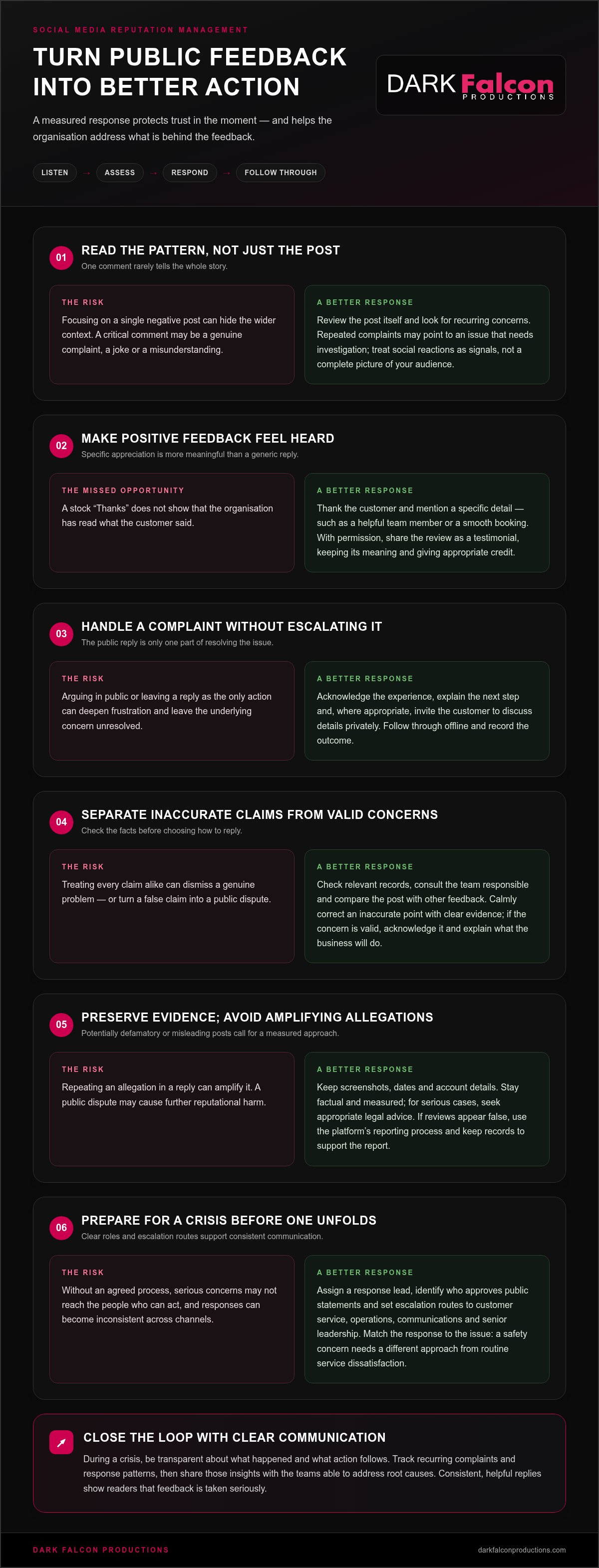
Reputation management is the ongoing work of listening, responding and improving people’s experience of a business. On social media, that means handling positive feedback thoughtfully, treating negative comments as useful signals and ensuring serious concerns reach someone who can act. A response is not just a reply to one person. It also shows other readers the organisation’s standards.
For a positive review, thank the customer and refer to a specific detail they mentioned. If someone praises a helpful team member or a smooth booking, acknowledge that experience instead of posting a generic “Thanks”. This shows you’ve read the feedback. With permission, you can also share the review as a testimonial, preserving its meaning and giving the customer appropriate credit.
A negative review calls for a different approach. Acknowledge the customer’s experience, avoid arguing in public and explain the next step. For example, a restaurant responding to a complaint about a delayed booking could apologise for the disruption and invite the customer to discuss the details privately. Follow through offline and record the outcome rather than leaving the public reply as the only action.
Separate false claims from genuine concerns before replying. Check relevant records, consult the team responsible for the service and compare the post with other customer feedback. If the claim is inaccurate, calmly correct the specific point and provide evidence readers can understand. If the concern is valid, acknowledge it directly, explain what the business will do and don’t present an excuse as a solution.
For negative or potentially defamatory posts, preserve screenshots, dates and account details before taking action. Avoid repeating the allegation in your response, which could amplify it. False or misleading posts can raise legal concerns, and a public dispute can cause further reputational harm. Keep your response factual and measured, and seek appropriate legal advice for serious cases.
Prepare a crisis process before a post gains momentum. Assign a response lead, identify who approves public statements and set clear escalation routes to customer service, operations, communications and senior leadership. A safety concern, for instance, needs a different response from dissatisfaction with a routine service. During a crisis, communicate transparently about what happened and what action follows. Use analytics to track recurring complaints and response patterns, then share those insights with the teams able to address root causes. Clear social media management can help keep responses consistent across channels.
3. How Can Social Media Impact a Company’s Online Reputation?
Social media gives customers a public place to share experiences, ask questions and challenge a company’s claims. A helpful exchange can build trust; an ignored complaint can cause damage when others see it go unanswered. Still, visible reactions are not a complete picture of your audience. People who post online may differ from customers who stay quiet, so treat comments as signals to investigate, not a vote representing everyone.
The quality of each interaction shapes credibility. A specific reply to a product question shows more care than a copied response. You can also invite feedback after a purchase, then compare comments with support enquiries and reviews for a broader view of recurring experiences. Responding to useful suggestions can strengthen relationships, especially when you explain what changed as a result.
Use customer feedback to identify criticisms that recur across channels. Group comments by subject, such as unclear pricing, delivery delays or difficult account access. Note where they appear and whether the same issue reaches customer service. Review these patterns regularly and share them with the team responsible. A cluster of complaints about one process may reveal a practical problem that a single comment would not.
Prioritise messages by potential harm and urgency. Reports of unsafe use, exposed personal information or a service disruption need rapid escalation. A suggestion about a minor design detail can wait for a considered reply. Set clear internal routes so the social media responder knows who handles operational, privacy or safety concerns. For complex complaints, acknowledge them publicly, move personal details to a private channel and provide a clear update when there is useful information to share.
UK brand communications are shaped by several frameworks. The Consumer Rights Act 2015 and the Data Protection Act 2018, alongside UK GDPR, are relevant to consumer protection, advertising and customer data; the National Archives (legislation.gov.uk) records the Acts. The CAP Code covers fair advertising, influencer marketing and promotions. Clearly label paid or sponsored posts, such as with #ad, so audiences can recognise commercial content.
No single response time suits every social media exchange. Expectations depend on the channel, the issue’s urgency and whether the brand has set clear support hours. Acknowledge urgent concerns promptly and give other enquiries a realistic update. If a conversation needs account details or a detailed investigation, take it offline without leaving the public thread unanswered. Then use the outcome to improve the service, not just close the conversation.
4. Social media reputation management strategy
Build a strategy around clear objectives, audience needs and company values. Decide which channels matter most, what each should communicate and who owns its daily activity. For example, a professional services firm might use LinkedIn for industry insight and another platform for customer updates, or collaborate with a dedicated PR firm for investment firms to safeguard high-stakes corporate messaging. Keep imagery, tone and language consistent, so each post supports the same identity rather than creating mixed signals.
Set a monitoring routine and add real-time alerts for emerging problems. Search online for company mentions regularly, including product names and campaign phrases. Social listening tools can gather mentions, comments and hashtags across channels. Online reputation management software can consolidate information from multiple sources, automate monitoring and help reveal sentiment patterns. Choose tools that fit your workflow, rather than collecting data no one reviews.
Measure outcomes against a clear starting point. Track changes in positive, neutral and negative mentions, response times, recurring complaint themes and resolved issues. Review these measures alongside customer service feedback. If negative comments about confusing delivery information persist, compare social data with support enquiries and improve the explanation customers see. The aim is to connect reputation management with visible improvements, not simply count posts.
Audit social media channels periodically against your mission and values. Check profile details, pinned posts, campaign language and older content for accuracy and consistency. Assign crisis handlers in advance, with responsibilities for monitoring, fact-checking, approval and public communication. Set escalation thresholds, automated alerts and real-time reporting in your crisis protocols, so sudden complaint spikes reach the people able to act.
Respond publicly on the same channel when people raise a recurring concern. A clear update can explain what the organisation understands, what it is doing and where customers can get further help. For individual cases, protect personal details by moving the conversation to a private channel. If a review appears false, preserve relevant records and use the platform’s reporting process. Removal is not guaranteed.
Reputation management can involve planning, channel monitoring, content development and response coordination. For organisations needing comprehensive support across channels, partnering with an agency such as jWeb Media can help unify content and brand presence. Start by identifying the gap: your team may need stronger listening routines, a consistent publishing plan or clearer escalation. Keep internal owners accountable for decisions and customer outcomes. A useful strategy turns audience feedback into informed action, while high-quality content reinforces the values you want people to recognise.
5. Why brand reputation on social media matters
A social media reputation can influence whether consumers consider a business before visiting its website, contacting its team or making a purchase. It is more than a communications concern. Public responses, reviews and shared experiences give people evidence to judge credibility, especially when comparing businesses that offer similar services.
The effect reaches beyond the audience already following a brand. HubSpot reports that 71% of consumers are more likely to purchase products and services based on social media referrals. A recommendation or customer story can therefore help a business earn consideration. By contrast, unanswered questions or a visible pattern of unresolved complaints may give prospective customers reason to hesitate.
Online reviews also influence how local businesses are assessed. In BrightLocal’s 2025 Local Consumer Review Survey, 42 percent of consumers said they regularly read online reviews when browsing for local businesses. Social media and review platforms can contribute to a consumer’s broader impression, even when the original comment concerns one interaction. A clear, considered presence helps explain how the business works and what customers can expect.
Reputation has practical consequences. When a customer shares a positive experience, thoughtful engagement can help that story reach a wider audience. When several people describe the same difficulty, their comments may expose a service issue that deserves attention. In both cases, value comes from treating public feedback as information and connecting it to decisions inside the organisation.
Visibility and credibility are not the same. Frequent posts alone don’t establish trust. A business builds a stronger presence when its public messages match its actions, its information stays accurate and its content offers genuine value. For example, a firm that promotes responsive customer care should make its support process easy to understand and follow. Consistency across these touchpoints gives consumers a clearer basis for confidence.
The business takeaway is straightforward: reputation deserves active attention because it can shape discovery, trust and purchasing decisions. Set aside time to review customer sentiment, identify what supports confidence and act on concerns that point to a real issue. Then use customer stories and useful content to show the organisation’s values in practice. A considered social media management approach can help turn that intention into a consistent public presence.
Dark Falcon Productions: Creative
Dark Falcon Productions helps businesses develop a considered social media presence through creative development, social media management and Shorts. If your team has clear values but needs a more consistent way to express them online, these services can support the creation and management of social content. Shorts offer a focused format for sharing ideas, updates or customer stories, while social media management brings planning and publishing together across your channels.
Turn to Dark Falcon Productions when you’re ready to shape your social content with a clear creative direction and a consistent voice. Visit Dark Falcon Productions to get in touch.
Shape your next chapter with purpose
A reputation is built through repeated business decisions, not one carefully worded post. Turn your values into a clear creative direction, then make that direction visible in the content your audience encounters. The question of how to protect brand reputation on social media becomes more manageable when your message, creative choices and daily channel activity work together.
Dark Falcon Productions offers Creatives, Shorts and social media management to help businesses develop and share social content with intention. These services can suit organisations ready to bring greater consistency to their social presence or shape ideas into concise, engaging formats. Strong execution starts with a defined purpose and a shared understanding of the story each piece of content should tell.
Choose a direction your team can sustain, then build on it with care. Contact Dark Falcon Productions today to discuss your creative direction and social media needs.
Frequently Asked Questions
What is reputation management?
Reputation management is the planned work of shaping, assessing and responding to public perceptions of an organisation. It connects communications with practical decisions, rather than treating every comment as a separate public relations task. For example, a retailer can record complaint themes, assign each to an internal owner and track whether operational changes improve customer feedback. A decision log also helps teams explain why they responded in a particular way.
What Is Social Media Brand Protection?
Social media brand protection means safeguarding how your organisation is represented across social channels and related digital spaces. Protect the accounts and creative assets behind that presence as well as monitoring public conversations. Keep official account ownership tied to company-controlled email addresses, limit administrator permissions to people who need them and store approved logos and campaign assets centrally. This helps distinguish authentic company communications from unauthorised use.
How Can Social Media Impact a Company’s Online Reputation?
Social media can influence how customers, prospective employees and business partners interpret a company’s actions. A short clip or screenshot may travel beyond its original discussion, sometimes without context. Prepare accurate background information for topics likely to attract questions, such as a product change or service disruption. This gives spokespeople a consistent basis for replies and helps readers understand the organisation’s position.
How Do I Stop Employees Or Partners Causing Harm To My Brand Online?
Set a written social media policy covering account ownership, confidentiality, approval routes and how staff should identify personal opinions. Review the policy regularly. Give employees and partners practical examples, such as how to handle confidential material or an unexpected press query. Remove access promptly when roles change, and assign one contact to update account permissions and approved brand assets.
What If My Business Uses Influencers, Ambassadors Or Paid Reviews?
Make the commercial relationship clear to audiences and brief every creator on the wording to use. UK businesses should clearly label paid or sponsored social media posts with disclosures such as #ad or #sponsored. The CAP Code is relevant to fair advertising, influencer marketing and promotions. Keep a record of the agreed content and disclosure, then review the published post to ensure the label is visible and the claims reflect the actual offer.
What are the best practices for protecting a brand’s reputation on social media?
To understand how to protect a brand’s reputation on social media, build safeguards into everyday publishing. Keep a record of approved claims, brand language and current product information, then use it during content review. Separate routine posts from material needing specialist approval, such as announcements about customer data or service changes. After a difficult exchange, document what happened and update guidance if the same confusion could affect future posts.
How can businesses monitor brand mentions and sentiment across social media platforms?
Start with a search list covering your organisation’s official name, common misspellings, product names and campaign phrases. Use platform searches and social listening software to collect relevant mentions, then label them by topic and tone. Review results alongside customer service records, since a burst of comments may relate to one event rather than a wider shift. Regular online searches can also surface mentions beyond social platforms.
Which social media monitoring tools compare best for UK businesses, and what do they cost?
Compare tools by the channels they monitor, their ability to identify mentions and sentiment, their reporting options and the number of people who need access. Google Alerts can surface web mentions, while social listening software can bring platform conversations into a more consolidated view. Costs depend on monitored channels, mention volume, user seats, archive access and reporting features. Match tool functions to your workflow before selecting a system.