
An event can fill every seat and still fail to move the business forward. Measuring the success of a corporate event means looking beyond attendance and activity to the behaviour changes and business outcomes it was designed to create. The key question is simple: did the event achieve its objectives, and what evidence supports that answer?
It’s understandable to feel pressure to prove value, especially when sales outcomes may take time to emerge and useful data is spread across registration records, attendee feedback, social channels and sales teams. The answer isn’t to track every available metric. Choose a focused set that reflects the event’s purpose and gives stakeholders a credible view of progress.
This guide shows you how to build a practical measurement plan, connect objectives to meaningful indicators, and gather evidence from attendees, stakeholders and business systems. You’ll also see how planned photography and video can document key moments and support post-event communications, alongside business data. The result is a clearer account of what changed, what remains uncertain and what to improve next time.
Key Takeaways
- Define success around the event’s purpose. A product launch, staff gathering and client event need different measures.
- Choose a compact set of KPIs that links each objective to relevant leading and lagging indicators.
- Set baselines, assign KPI owners and validate data from each source using a clear workflow.
- When measuring the success of a corporate event, distinguish observed results from interpretations and assumptions, and use ROI where financial outcomes apply.
- Turn the review into specific decisions about what to repeat, change, test or stop at your next event.
What does success mean when measuring a corporate event?
A full room, a polished schedule and lively conversations are signs of activity. They don’t, on their own, show whether an event achieved its purpose. Success means finding credible evidence that the agreed objectives were met, whether the intended change was greater product understanding, stronger client relationships or a clearer sense of direction among staff.
Event measurement is the planned collection and interpretation of evidence to determine whether an event achieved its agreed objectives and what should happen next. That makes measuring the success of a corporate event a question of purpose, not one universal score. Event management covers planning and delivery across different formats, so measures should reflect what each event was designed to do.
- Product launch: Look beyond registrations. Assess whether the intended audience understands the offer and takes a relevant next step.
- Conference: Consider whether attendees gained useful knowledge, made valuable connections or engaged with the themes.
- Staff event: Assess whether employees leave with greater clarity, confidence or alignment around a shared priority.
- Client gathering: Explore whether the event strengthened relationships or prompted meaningful follow-up conversations.
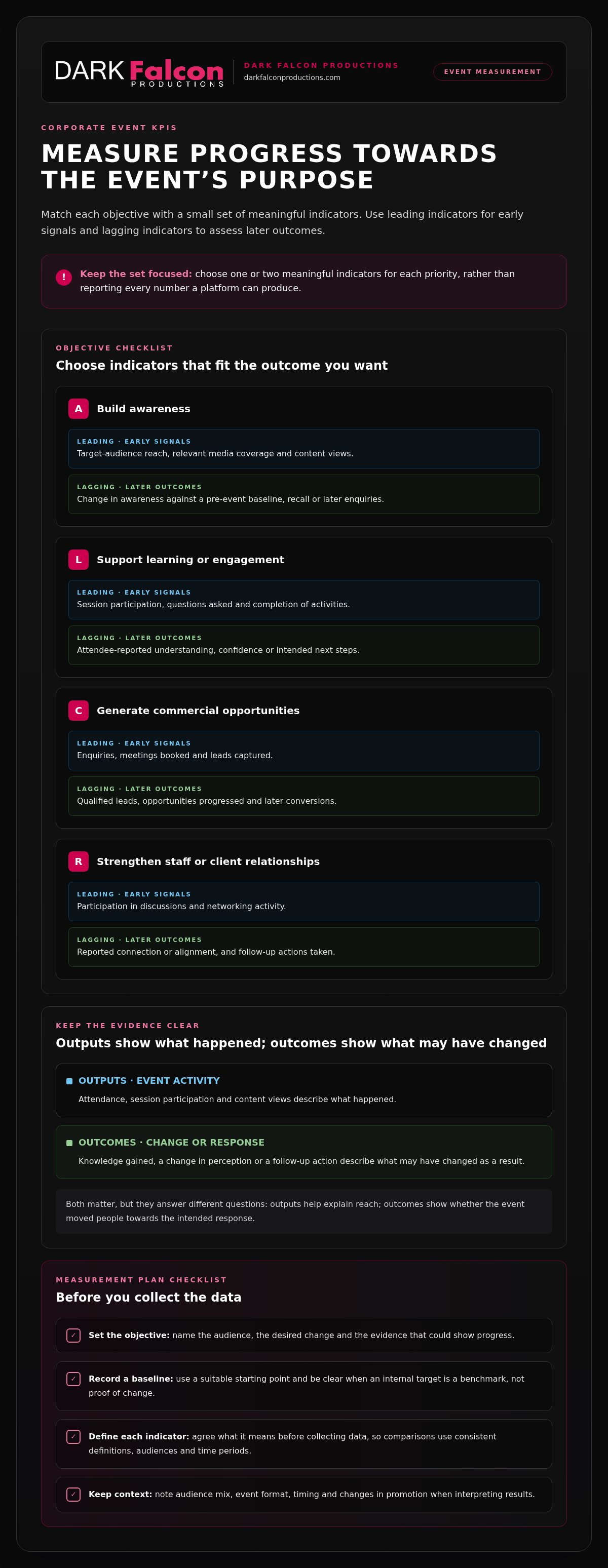
Keep outputs separate from outcomes. Attendance, session participation and content views describe what happened. Knowledge gained, a change in perception or a follow-up action describe what may have changed as a result. Outputs help explain the event’s reach; outcomes show whether it moved the audience towards the intended response. Both matter, but they answer different questions.
Turn the event purpose into a measurable objective
Start with the audience and the change you want the event to create. Use KNOW, FEEL, DO as prompts: what should people know, how should they feel, and what should they do afterwards? These are starting points, not KPIs. Turn one into a clear objective by naming the audience, desired change and evidence that could demonstrate progress.
For example, “raise awareness” is too broad to guide evaluation. A more useful objective might be: “Help prospective customers understand how the new service addresses a specific business challenge, then identify whether they request a follow-up discussion.” This points towards possible evidence without confusing the activity, such as a presentation, with the result it is meant to support.
Set a baseline before choosing success measures
Record the starting point before the event. This could include registrations for a comparable previous event, existing awareness research or the number of relevant enquiries already received. Decide which figures can be compared fairly by using consistent definitions, audiences and time periods. If no suitable baseline exists, set an internal target and be clear that it is a benchmark, not proof of change.
Comparisons need context. Audience mix, event format, timing, competing industry activity and changes in promotion can all affect results. Note these factors in the plan rather than explaining them away afterwards. Planned photography and video can document moments and support follow-up communications, but they complement rather than replace evidence of audience or business outcomes.
Which corporate event KPIs measure progress towards your objectives?
A useful KPI makes an event objective observable. Keep the set small enough to interpret: select one or two meaningful indicators for each priority rather than reporting every number a platform can produce. A KPI is meaningful only when it shows progress towards a specific event objective. The Performance Management principles described by the U.S. Office of Personnel Management similarly connect measurable outcomes with organisational goals.
Use leading indicators to show early signals of progress and lagging indicators to assess later outcomes. Choose measures that suit your event and audience, and agree how each will be defined before collecting data.
| Objective | Leading indicators | Lagging indicators |
|---|---|---|
| Build awareness | Target-audience reach, relevant media coverage, content views | Change in awareness against a pre-event baseline, recall or later enquiries |
| Support learning or engagement | Session participation, questions asked, completion of activities | Attendee-reported understanding, confidence or intended next steps |
| Generate commercial opportunities | Enquiries, meetings booked, leads captured | Qualified leads, opportunities progressed and later conversions |
| Strengthen staff or client relationships | Participation in discussions, networking activity | Reported connection or alignment, follow-up actions taken |
Choose indicators for engagement, learning and brand outcomes
Participation shows that people engaged with an element of the event; it doesn’t confirm what they learnt or how their view changed. Pair session attendance or questions asked with concise feedback on relevance, understanding and intended next steps. For awareness, compare reach and relevant coverage with a pre-event baseline. Social engagement can add context, but likes or shares alone don’t demonstrate business impact.
Keep questions focused. Ask attendees what was useful, what they understand more clearly or what they plan to do next. If you use photography or video, plan the coverage around the audience response you want to capture and how the content will be used afterwards. These assets can document participation and extend communications, but they aren’t substitutes for feedback or business-system data.
Measure leads, revenue and event ROI with care
Separate contacts collected from leads that meet your agreed qualification criteria. Then track whether qualified leads progress to opportunities and conversions, using consistent definitions with the sales team. Set a follow-up window that suits your typical sales cycle. A result reported soon after the event may not capture later influence.
Before calculating ROI, agree which event costs and attributable financial outcomes count. A common formula is (attributable return minus event costs) divided by event costs, multiplied by 100. Define attribution carefully: a later sale may involve several marketing and sales interactions. Report observed figures separately from estimates, and label assumptions clearly rather than assigning the full value of a complex sale to the event.
When visual documentation supports the intended audience response, planned event photography and video can capture key moments for follow-up communications. Treat this content as one part of a broader measurement plan, alongside attendee feedback and commercial evidence.
How do you collect reliable corporate event data before, during and after?
Reliable measurement depends on a clear chain from objective to evidence. Decide what you’ll capture, where it will come from and who is responsible before event day. This prevents useful information from being scattered across registration records, survey responses, social channels and sales systems with no clear way to bring it together.
Use this six-step workflow to organise the process:
- Define. Write down each KPI in plain language, including what counts and what doesn’t. If you’re tracking attendance, decide whether the figure means registrations, check-ins or people who attended a particular session.
- Baseline. Record starting figures and targets before invitations or promotional activity begin. Save the reporting period and definitions too, so later comparisons use the same basis.
- Assign. Name an internal owner for every KPI and data source. For example, the event lead could own attendance records, whilst a sales colleague updates lead status in the relevant business system.
- Collect. Set when and how each source will be captured. Registration and check-in data may be available during the event; feedback, stakeholder comments and sales progression are gathered at different points afterwards.
- Validate. Check records for missing values, duplicates and inconsistent definitions. Compare totals across sources where appropriate, and flag gaps rather than filling them with assumptions.
- Review. Bring the evidence together against the original objectives. Record what the data supports, what remains uncertain and which follow-up actions or further checks are needed.
Prepare the measurement plan before the event
Create a simple measurement register with one row for each KPI. Include its definition, data source, collection time, named owner and intended comparison. Draft survey questions and agree tracking conventions before event communications go out. For lead follow-up, align the fields to record, such as contact details, stated interest and agreed next action, with the team responsible for updating them.
Set a consistent method for recording attendance and participation. For example, decide whether session participation means a check-in, a completed activity or a contribution to discussion. Keep the process practical and unobtrusive. A shared plan helps colleagues collect information consistently instead of reconciling different interpretations afterwards.
Collect and validate evidence during and after the event
During the event, capture live indicators with as little disruption as possible. Use the agreed check-in process, note relevant questions or activity, and record stakeholder observations while details are fresh. Planned event photography and video can document moments and create material for post-event communications. They show what was visible, but don’t prove that attendees learnt, changed their views or took action.
Invite attendees to give concise feedback soon after the experience, then review response patterns alongside registration, attendance and business-system records. Check for duplicate contacts, incomplete responses and mismatched time periods. Before measuring the success of a corporate event, make sure each conclusion reflects the quality and limits of the evidence behind it.
How should you interpret event results, ROI and attendee feedback?
Results need context before they can support a decision. Compare each KPI with its baseline and target, then use past events only when the audience, event format, time period and metric definitions are sufficiently similar. A difference between events may signal a useful change, but it could also reflect different conditions or other activity.
A result that follows an event does not prove the event caused it. A rise in enquiries after a conference, for example, may be consistent with event influence, but other marketing, sales conversations or market changes could also have contributed. Describe what the evidence shows, what it reasonably suggests and what remains an assumption. This discipline is central to measuring the success of a corporate event credibly.
ROI offers a financial lens, not a complete verdict. It can help assess events with attributable financial outcomes, such as qualified opportunities or revenue, but objectives such as improved understanding, stronger relationships or staff alignment may not translate directly into money. Report those outcomes against their own measures rather than forcing every result into a financial score.
Combine financial results with qualitative evidence
Bring lead or revenue data together with attendee, sponsor and internal stakeholder feedback. Numerical results show scale or progression; comments can help explain what people found useful, confusing or motivating. Look for recurring themes across different groups, while treating individual comments as perspectives rather than proof of a universal response.
Keep mixed findings visible. Attendees might rate the content highly whilst reporting limited confidence about applying it, or sales teams might value the conversations but see few qualified leads yet. These aren’t contradictions to smooth into one score. They point to different parts of the experience or follow-up that need attention.
Report findings as decisions, not just dashboard figures
For each objective, give readers a concise account of the intended outcome, selected KPIs, results, interpretation and recommended action. State the comparison used and note gaps in the evidence, such as incomplete feedback or a long sales cycle. Label attribution assumptions clearly, especially where several activities may have influenced a later conversion.
Use a small number of clear charts, captions and relevant event visuals to make the evidence easier to follow. Photography and video can give a report context by showing participation, speakers or key moments, and can support post-event communications. They illustrate what happened, but can’t establish learning, sentiment or business impact on their own.
Close each finding with a decision: retain the format, adjust a session, refine follow-up or gather stronger evidence next time. If professional event photography and video would help document key moments and support your event communications, plan event photography and video production as part of the wider measurement approach.
How can event measurement improve your next corporate event?
Measurement becomes valuable when it changes what you do next. A post-event review should turn findings into a practical plan, not simply archive a report. Capture decisions while the evidence is fresh, then carry useful definitions, baselines and lessons into the next event. This makes comparisons more meaningful and helps teams build on what worked rather than starting from scratch.
Create a practical post-event improvement cycle
Bring together the event team, marketing colleagues and relevant business stakeholders. Review each objective against its measures, then agree what to repeat, change, test or stop. Keep the discussion grounded in evidence: if attendees found a session useful but follow-up actions were limited, consider whether the next step was clear enough or post-event communication needs refining.
Turn each conclusion into an action with a named owner and timeframe. A short action register can include:
- Repeat: an element supported by strong evidence, such as a session format linked to high participation and positive feedback.
- Change: a component that fell short of its intended purpose, with a clear adjustment for the next event.
- Test: an idea where the evidence is mixed, so a defined trial can help reveal what works.
- Stop: an activity that used resource without clear value against the agreed objectives.
Before planning the next event, revisit the objective and KPI definitions. Keep them consistent where the purpose and audience are comparable, and record any changes in format, audience or measurement method. If the objective changes, update the measures too. This creates a learning cycle: review evidence, assign improvements, apply them, then assess the next event against a fair point of reference.
Bring event documentation into the measurement plan
Photography and video can preserve moments that support the event narrative, such as a product demonstration, panel discussion or staff participation. Plan visual coverage around the intended audience response and how the material will be used afterwards. Selected assets can extend event communications through post-event updates and social content, while giving stakeholders a vivid record of the experience.
Visual documentation is supporting evidence, not a substitute for feedback, attendance records or business outcomes. Pair it with measures that show whether people understood, responded or acted. A coordinated production approach can connect event delivery with useful post-event content, including event photography and video integration or cinematic event highlights. Keep the purpose clear: capture material that serves the audience and gives future communications a strong, consistent story.
As you shape your next measurement plan, consider how event production and visual coverage can support both the experience and its follow-up. Discuss the priorities for your next corporate event and how coordinated production could help document and extend its story.
Make your next event a stronger starting point
Your next event can build on more than a set of results. Treat the measurement plan as part of the creative brief: decide what the audience should take away, what evidence will help you understand their response, and how the event story should continue afterwards. That connection gives teams a clearer purpose for every production choice, from the moments captured to the content shared after the event.
Measuring the success of a corporate event becomes more useful when insight shapes the next experience. Corporate event production and professional photography can document key moments, while video production, editing and social media content can carry selected messages into post-event communications. Creative content tailored for different platforms helps keep that story coherent, with business data and audience feedback providing the wider evidence.
Bring your objectives and ideas together at the outset. Discuss your next corporate event and explore how thoughtful production and visual coverage can support its purpose. Each event is an opportunity to create a more considered experience and make the next decision with greater confidence.
Frequently Asked Questions
Is attendance a reliable measure of corporate event success?
Attendance is useful when your objective involves capacity, demand or reach, but it can’t show by itself whether people engaged, learnt or acted. Compare registrations with actual attendance to see where interest translated into presence. Then add a measure that reflects the purpose, such as whether attendees at a training event can identify a key takeaway. Attendance is one useful signal, not a complete assessment.
How many KPIs should a corporate event have?
Choose a focused set that reflects the event’s objectives rather than filling a dashboard with every available metric. For measuring the success of a corporate event, each KPI needs a clear definition, a reliable data source and a named owner. The right number depends on the event’s scope and goals. Keep secondary measures for context, but prioritise indicators that can inform a decision.
Can you measure a corporate event without ticket sales?
Yes. Ticket sales aren’t necessary, particularly for internal, hosted or invitation-only events. A staff briefing, for example, could be assessed through participation, feedback on clarity and whether employees complete an intended follow-up action. Client gatherings might use feedback or subsequent meeting activity. Choose evidence that reflects the audience and purpose, not how people registered or whether they paid to attend.
What is a reasonable response rate for an event survey?
There isn’t one response rate that suits every event. Audience expectations, survey length, timing and how the survey is shared can all affect participation. Report the number of responses alongside the number of people invited or attendees, so readers can understand the scale of the feedback. A concise survey with clear questions can make responding easier. Note that respondents may differ from people who didn’t reply.
How can you measure networking outcomes at a corporate event?
First decide what successful networking means for the event, such as new peer connections or introductions that lead to follow-up meetings. You could use attendee feedback, participation in planned networking sessions or recorded follow-up connections where these are tracked. A contact count alone can’t establish relationship quality or business value. Respect attendee privacy, and recognise that informal conversations can’t all be captured or reliably attributed.
When should you review corporate event results?
Review immediate indicators, such as attendance and initial feedback, soon after the event, whilst the experience is fresh. Other outcomes need more time: a lead may progress through a sales process, or an attendee may act on a new idea later. Set review points that suit the objective and relevant sales or communication cycle. Record the date of each review so comparisons reflect the same observation period.