
A polished B2B video isn’t a business result unless it gives the right audience a reason to act. Professional b2b video production starts with the business objective, then shapes the story, format and distribution around it.
Choosing the right kind of video can feel uncertain. Your team also needs to contribute without losing focus on its day-to-day work, and creative decisions should connect to a clear purpose beyond the final edit. Address these concerns before production begins by aligning the brief, audience and intended use.
This guide sets out a practical framework for taking a B2B video from first brief to finished film. You’ll learn how to define the objective, select a format that suits your audience and plan production around your team’s time. It also explains how editing and distribution fit into the process, so the final video is prepared for the platforms and moments where it can do its job.
Key Takeaways
- Anchor professional b2b video production in a specific communication need so each creative decision has a clear purpose.
- Map the journey from brief and development to filming, editing and a final cut prepared for its intended use.
- Match the video format to your objective, whether you’re introducing an idea, promoting an offering or capturing an event.
- Prepare your team by agreeing key messages, contributors and practical details before filming begins.
- Use a collaborative production process to shape an idea into a polished video, with editing and distribution considered along the way.
Why professional B2B video production starts with a business objective
Making a video and solving a communication need are different tasks. A film can look polished yet leave its audience unsure what the business does, why a change matters or what to do next. Start with the need, then decide how video can address it. This keeps the creative brief focused and gives the production team a clear foundation for developing the story.
“B2B video production is the planned creation of video content for a business audience, shaped by a specific communication purpose.”
That purpose influences every decision: who appears on screen, which information takes priority, how the story is told and where the finished video will be used. Professional b2b video production is most useful when these choices serve the same objective, rather than follow a platform trend simply because it is popular.
What business problem should a B2B video solve?
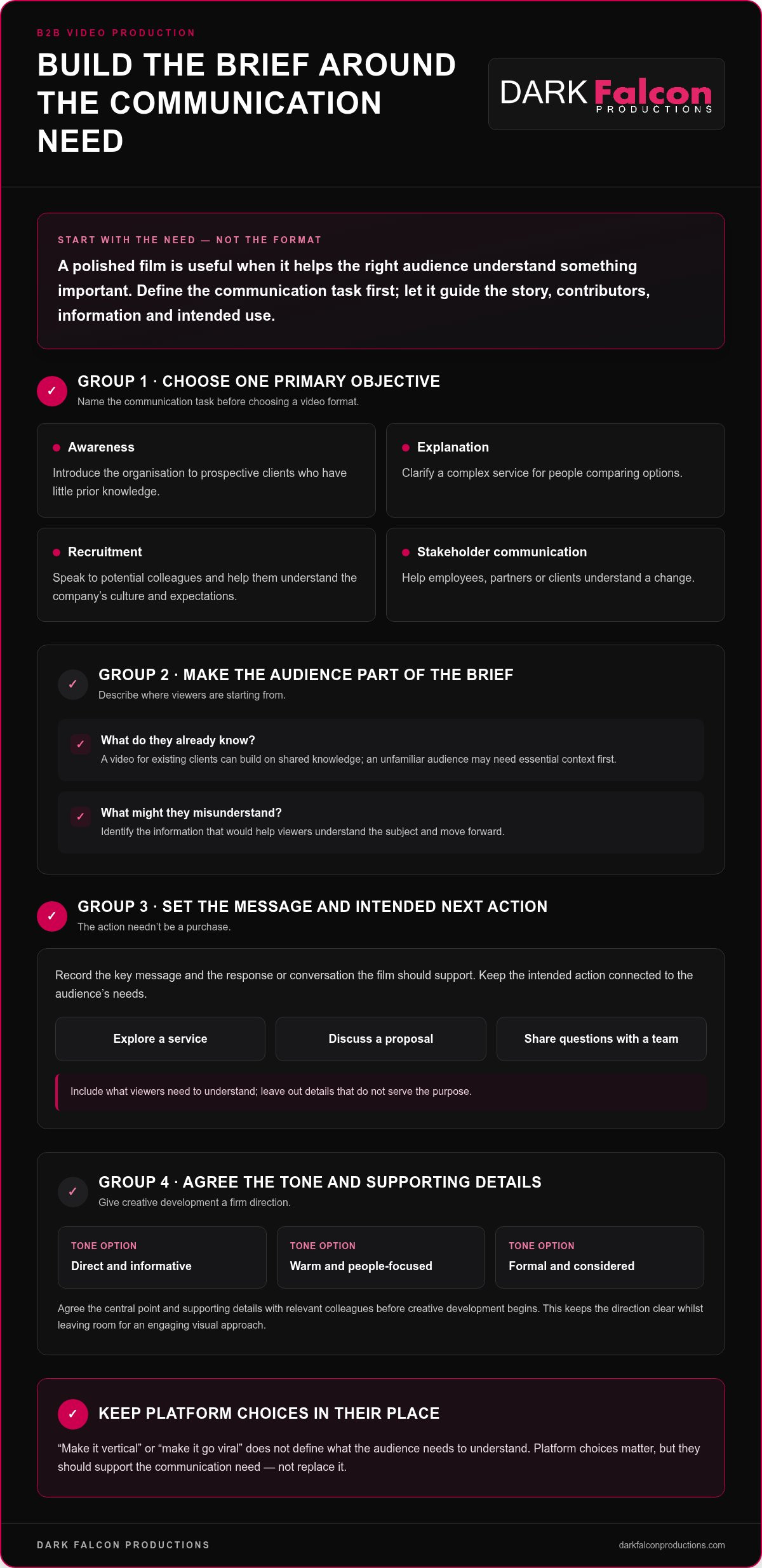
Define the communication task before settling on a format. Awareness content might introduce an organisation to prospective clients who have little prior knowledge. An explanatory video can clarify a complex service for people comparing options. Recruitment content speaks to potential colleagues, while stakeholder communication may help employees, partners or clients understand a change.
Each objective calls for a different audience and information need. A prospective client may need a concise account of the problem addressed and the organisation’s approach. A new employee may need to understand the company’s culture and expectations. A stakeholder following a change may need context, rationale and practical implications. These distinctions affect the script, contributors and level of detail.
Write the brief around one primary objective. Record the audience, key message and intended next action, such as exploring a service, discussing a proposal or sharing questions with a team. A trend-led brief that begins with “make it vertical” or “make it go viral” skips the central question: what does this audience need to understand? Platform choices matter, but they should support the communication need.
How to make the intended audience part of the brief
Describe the audience’s starting point. What do they already know? What might they misunderstand, and what information would help them move forward? A video for existing clients can build on shared knowledge. One for an unfamiliar audience may need to establish essential context before introducing a detailed message.
Next, identify the decision, behaviour or conversation the video should support. The intended action needn’t be a purchase. It could be a discussion with a colleague, a response to an internal announcement or a better-informed evaluation of a business issue. A clear purpose helps determine what belongs in the film and what can be left out.
Set expectations for tone and message in the brief. Should the film feel direct and informative, warm and people-focused, or formal and considered? Agree the central point and supporting details with relevant colleagues before creative development begins. This gives the production process a firm direction whilst leaving room to find an engaging visual approach.
Professional video also involves distinct planning, filming and editing stages. Wikipedia’s overview of the stages of video production offers useful context. The business objective connects those stages so the finished film stays aligned with its intended audience and purpose.
How professional B2B video production moves from brief to final cut
A clear objective gives the project direction. The production lifecycle turns that direction into a finished film through connected stages, from developing the idea to filming, editing and approval. Each stage has a distinct focus: planning establishes what the team will make, filming captures the material, and post-production shapes it into a coherent video.
“B2B video moves from brief and creative development through filming, editing and approval to a final version prepared for its intended use.”
Briefing and creative development before filming
The brief brings the project’s essentials into one place: objective, audience, core message, intended format and distribution context. It should also identify key contributors, essential information and practical filming considerations. This gives the creative team a shared reference instead of leaving important decisions until the day of filming.
Creative development translates those priorities into a production direction. This may involve shaping the narrative, deciding how information will be presented and identifying the scenes or people needed to tell the story. A concise outline or script helps the client team review the direction before filming begins. Once the central idea is agreed, contributors can prepare their points and the production team can plan the required footage.
Filming, editing and feedback through to delivery
Filming is the capture stage. Contributors, locations and planned scenes come together under the agreed creative direction. The focus is on recording the material needed to communicate the message clearly, while allowing room for natural moments that add authenticity. Good preparation helps keep the shoot purposeful and reduces the risk of discovering that a key point or visual is missing during editing.
Editing gives the footage structure. The editor selects and arranges shots, shapes the pace and refines the story so the most important information is easy to follow. Professional video production and editing can take an idea from captured material to a polished final cut, with choices guided by the brief and intended viewing context.
Feedback works best when it has a clear route. Agree who gathers comments and who approves the film on behalf of the business. Reviewers can then focus on factual accuracy, message clarity and whether the video serves its intended purpose. Consolidated feedback helps the creative team distinguish essential changes from individual preferences, keeping the agreed direction intact without assuming a fixed number of revisions.
Before delivery, align approval with the planned use: confirm the intended version and check that the edit suits its destination. If you’re shaping a project, explore how Dark Falcon Productions’ video production can support the journey from creative direction to final edit.
Which professional B2B video format fits your business objective?
The right format depends on what the audience needs to understand and what the business wants the video to communicate. A short film, an explainer, a promotional video and event coverage each serve different purposes. None is automatically the best choice. Match the format to the message, the viewers and where they’ll encounter the finished film.
“Choose a video format to serve the communication objective, not the other way round.”
Use this comparison to clarify the direction of your professional b2b video production project:
| Business need | Suitable format | Key planning consideration |
|---|---|---|
| Present a focused story or idea | Short film | Decide which central message or perspective the story should carry. |
| Make a service, process or concept easier to follow | Explanatory content | Identify what the audience needs explained and what context they already have. |
| Communicate a brand, offer or business message | Promotional video | Set the priority message and the audience the video needs to reach. |
| Capture an event for people who attend or couldn’t be there | Event coverage | Choose which moments, speakers or atmosphere matter to the intended viewers. |
When a short film or explanatory video suits the brief
A short film can use a focused story to bring an idea, perspective or business theme to life. Its structure might centre on one contributor, a sequence of moments or a single message. Keep the scope deliberate: including every detail can weaken the story’s focus.
Explanatory content takes a different route. It organises information so viewers can follow a service, process or concept step by step. Let the audience’s existing knowledge guide the amount of context and the structure. A familiar topic may need only a concise overview; an unfamiliar or complex one may need more room to establish terms and explain how the parts connect.
When promotional or event video serves a different need
Promotional video brings a brand, offer or business message into focus. Before shaping the creative approach, decide what viewers should remember and which details support that point. The video can then prioritise the most relevant story instead of trying to include every feature or message at once.
Event coverage captures selected moments and the atmosphere of an occasion. The plan changes with the event and its intended audience. A video for attendees might emphasise shared highlights, whilst one for people who weren’t present may need context, key contributions or a sense of the event’s purpose. Decide what should be captured and how the footage will be used afterwards. That clarity helps shape a format that suits both the occasion and its viewers.
How to prepare your team for professional B2B video production
A well-prepared client team helps keep filming focused and gives the creative work a clear foundation. Preparation doesn’t mean scripting every moment or controlling every detail. It means making key decisions early, so contributors understand their role and the people responsible for approvals can give useful, consistent feedback.
Use this checklist to get your team ready:
- Agree the main message and the essential information the video must include.
- Choose a project lead who can coordinate input and gather feedback.
- Prepare contributors with a clear outline of the purpose, audience and intended tone.
- Consider the filming setting, participants and any practical requirements that could affect the shoot.
- Decide where the finished video will appear and what viewers should be able to do or understand afterwards.
Align stakeholders, message and approvals
Identify who makes the final decisions and who needs to contribute specialist knowledge. Ask one person to consolidate internal comments, rather than sending conflicting notes from several departments. This keeps feedback easier to interpret and helps protect the agreed message.
Before filming, confirm essential points such as correct names, terminology, claims and supporting details. Also agree how the team will review material and when input is needed. Review points can be shaped around the project, but responsibilities should be clear from the outset. A conversation about creative direction for video can help stakeholders align expectations and give the production team a coherent starting point.
Prepare contributors, locations and distribution plans
Contributors don’t need to memorise a script to be prepared. Share the main idea, who the video is for and the tone it should carry. Explain whether they’ll speak directly to camera, take part in a conversation or demonstrate something. Understanding the purpose helps people contribute naturally and stay on message.
Think through the chosen setting before filming. Consider access, background activity, noise, available space and whether the people or materials needed for the planned scenes will be ready. These practical checks help the team anticipate distractions and make better use of filming time.
Distribution deserves attention before the shoot, too. List the intended destinations, such as a website, presentation or social channels, and share relevant platform requirements with the production team. A video designed for a particular audience and viewing context may need a different edit or framing from one intended for another use. Clear plans help shape delivery around how the content will actually be used.
Dark Falcon Productions creates professional video content collaboratively, tailoring the creative process to project requirements. Plan your B2B video production with a prepared team and a clear sense of what the finished film needs to achieve.
What a professional B2B video production partnership can deliver
A production partnership brings creative development and practical execution together. Dark Falcon Productions is a UK creative production company working with business and creative clients on professional video production, editing and short-film creation. The aim is to carry the original brief through to finished content with a clear creative direction, rather than treat filming as a standalone task.
That collaboration begins with understanding what the project needs to communicate. A strong working brief gives the client and production team a shared reference for the story, contributors and intended use. From there, creative development shapes the idea into a production approach, and editing brings the captured material together as a considered final film.
From a tailored brief to platform-ready video content
Video content can be tailored to client requirements and intended platforms. A film prepared for a website may need a different structure from content planned for social channels or a presentation. Naming those destinations early helps the team consider how the video will be framed, edited and delivered, without losing sight of the main message.
Keep the brief specific enough to guide decisions, but open enough for creative ideas to develop. Clarify the audience, essential information and where the content will appear. This gives production and editing a shared direction from development through to the final version.
Extend the video’s role with related creative services
Once the film is ready, consider how it fits into the wider content plan. Social media management can support the organisation and use of video across relevant channels, helping the content sit alongside other communications. The distribution plan should reflect the audience and purpose, rather than assume the same cut will suit every destination.
For broader context on professional video production in the UK, consider how a production company’s creative and practical capabilities relate to your project. Post-production also plays a central role: professional video editing shapes footage into a coherent, polished piece, with pacing and structure guided by the intended audience and message.
A thoughtful partnership keeps the brief, creative choices and final content connected. It gives your team a clear point of collaboration as the project takes shape, from developing the story to preparing the edit for its intended use. The finished video can then reflect the requirements established at the outset, without promising a particular business outcome.
If you’re ready to shape an idea into a B2B film, discuss your video project with Dark Falcon Productions. Bring your brief, audience and intended use into the conversation, and begin developing a production direction suited to your needs.
Give your next business story room to take shape
A video project can begin a useful creative conversation inside your organisation. Use it to clarify what your business wants to say now, then notice which questions and ideas emerge as the content is shared. Those insights can help guide future creative work, without expecting one film to answer every need.
Approach professional b2b video production as a purposeful investment of attention: decide what deserves to be seen, who should shape the story and how the finished work can remain useful beyond its first viewing. A considered brief gives that ambition somewhere to begin.
Bring your early ideas, audience and intended purpose into a conversation with Dark Falcon Productions. Explore your B2B video project and take the next step towards a film shaped around your business. A clear idea is a strong place to start.
Frequently Asked Questions
What is professional B2B video production?
Professional B2B video production creates video content for communication between businesses, such as explaining a service to prospective clients or sharing an organisational update with partners. The work combines a clear message with considered visuals, sound and editing. For example, a specialist business might use a concise film to introduce its approach, then provide a more detailed video to support a client presentation. The intended audience determines what belongs in each piece.
Which types of video work well for B2B businesses?
Explainer videos, promotional films, short films, interviews and event coverage can all suit B2B communication. The best option depends on the task: an interview can give a subject-matter expert room to clarify a point, whilst event footage can help share selected moments with people who weren’t there. A business might also create a short version of a longer explanation for a social channel. Plan the content around the viewer’s needs, not the format alone.
How does a B2B video production process work?
A B2B video project typically begins with a discussion of the communication need, audience and intended use. The creative approach is then developed, filming captures the planned material, and editing shapes it into a finished piece. For a practical handover, nominate one person to provide consolidated feedback and ensure subject experts review details they know best. That division of input helps the production team receive clear guidance without making every colleague responsible for every decision.
How long does it take to produce a professional B2B video?
Production time varies with the project’s scope, filming arrangements and the speed of feedback and approvals. A straightforward piece with one contributor may involve fewer creative and logistical decisions than a film requiring several locations, participants or detailed visual development. Allow time for internal stakeholders to prepare and review material, too. Sharing key dates and decision-making responsibilities at the outset helps the team plan the work realistically, without assuming every project follows the same schedule.
How much does professional B2B video production cost?
The cost of professional b2b video production depends on what the project needs, so there isn’t one useful price for every brief. Factors can include the creative development required, filming arrangements, number of contributors, editing complexity and versions needed for different uses. A focused outline helps clarify the work involved. When setting a budget, consider the complete project, including post-production and preparing content for its intended destinations, rather than looking at filming alone.
How can a business use its B2B video after production?
A business can use a finished video in the context it was made for, such as a website page, sales presentation, internal update, event follow-up or relevant social channel. It can also consider whether shorter edits or clips would serve other audiences, provided each version retains accurate context and a clear message. Keep track of where the video is shared and review whether it remains suitable as the business’s services, messaging or audience needs change.