
What if your brand’s most compelling story isn’t about what you do, but what changes for the people you serve? Professional storytelling for brands starts with that shift in perspective. When messaging centres on the organisation, it can feel generic; when it reflects an audience’s needs and ambitions, it gives people a reason to pay attention.
If your content feels disconnected across channels, you’re not alone in facing the challenge: a clear purpose can be difficult to turn into a story people recognise. And storytelling isn’t simply a creative trend. A strong narrative gives your communication direction, helping each piece of content reinforce what your brand stands for.
This article explores how to build a credible brand narrative from audience insight, purpose and proof. You’ll learn how to keep that story consistent across formats, choose each format for a clear reason, and make your message tangible through video, photography and social content. The principle is simple: put the audience’s change at the centre, then shape the production around it.
Key Takeaways
- Separate a genuine brand story from slogans, company history and feature lists by clarifying the audience’s needs and the brand’s role.
- Use audience, tension, meaningful change and credible evidence to give your narrative a clear progression.
- Match origin, customer-centred, mission-led or behind-the-scenes storytelling to the message you need to communicate.
- Apply a five-step framework to shape your story and create a concise brief that aligns stakeholders before production.
- See how professional storytelling for brands can take shape through purposeful video, photography, editing and social content.
What professional storytelling for brands means, and what it is not
A brand story connects audience needs, meaning and the brand’s role. That is the clearest way to define it: not a polished speech about the organisation, but a purposeful account of why something matters to the people it serves and how the brand contributes.
Professional storytelling for brands is more than a slogan, an origin story or a list of features. A slogan can express an idea, and a company history can explain where a business began, but neither automatically shows why an audience should care. A list of features provides useful facts, yet leaves the audience to work out their relevance. A narrative links those facts to a human need and gives them a place in a larger message. The broader practice of Organizational storytelling also shows how stories can support communication and shared understanding within organisations.
What makes a brand story feel credible?
Credibility begins with a recognisable audience need. The audience, not the organisation, should be at the centre of the change. The brand’s purpose then needs to connect to an experience people can understand, rather than appearing as an abstract mission statement. Specific, substantiated details help make that connection tangible. Keep evidence separate from ambition: describe what the brand does and can demonstrate, and frame future goals as intentions rather than completed achievements.
Consistency matters, too. A story loses force if the website, a video and social posts suggest different values or make conflicting claims. Consistency doesn’t mean repeating identical wording in every format. It means preserving the same underlying point, tone and evidence while adapting the expression to the audience and context.
Storytelling versus feature-led brand messaging
Facts still matter. Narrative gives them context, helping an audience understand why a feature is relevant and what need it may address. Consider a hypothetical company that makes reusable lunch containers. A feature-led message might list the material, size and colour options. A story could instead begin with someone looking for a practical way to bring lunch to work, then show how those product details relate to that everyday need. The example makes no claim about a real brand or result.
The distinction is not between facts and feelings. It is between facts presented without a clear connection and facts arranged to make that connection visible. Emotional language alone cannot establish credibility; evidence must support the claims, and the audience’s experience should remain central.
- Audience: Whose need or challenge does the story address?
- Meaning: Why does that need matter in their day-to-day experience?
- Brand role: What can the organisation credibly contribute?
- Evidence: Which details support the story, and which points are aspirations?
These questions offer a useful test before a story moves into production. If the message relies mainly on praise for the organisation, a sweeping promise or an unsupported claim, return to the audience’s need and clarify the brand’s actual role. A grounded narrative can still be imaginative. Its creative choices simply remain accountable to what the brand can show and say consistently.
The narrative mechanics behind effective brand storytelling
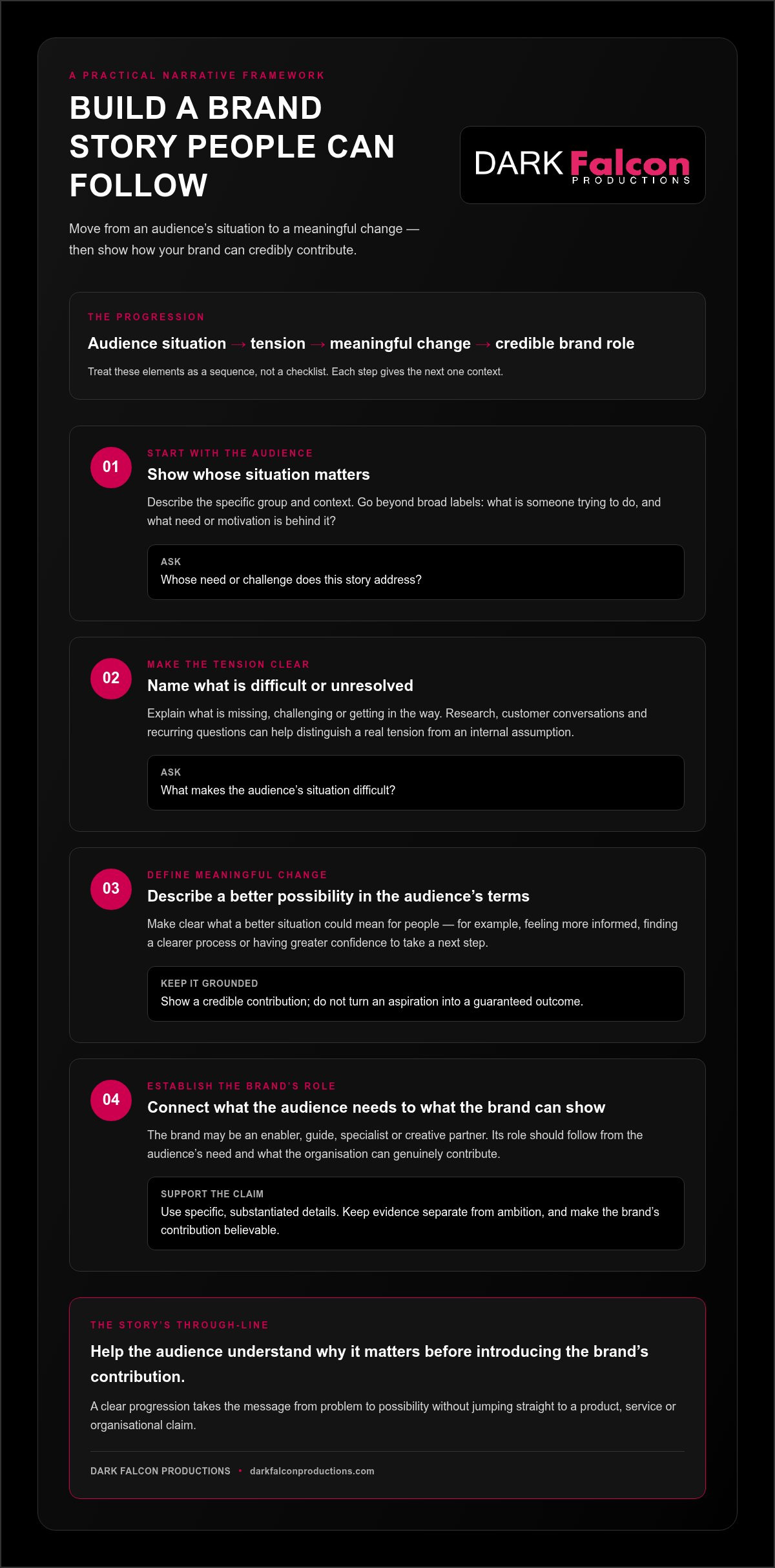
A useful brand narrative moves through four connected elements: audience, tension, meaningful change and the brand’s credible role. A brand narrative framework connects an audience’s situation to a meaningful change and shows how the brand can credibly support it.
Think of these elements as a sequence, not a checklist. First, the audience recognises a situation that matters to them. Next, the tension makes clear what is difficult, missing or unresolved. The story then opens a route towards a more useful possibility. Finally, the brand shows where it can contribute, with evidence that makes its role believable.
This order gives people a way to follow the message from problem to possibility. It also prevents the narrative from jumping straight to a product, service or organisational claim before the audience understands why it matters.
Start with the audience and the change they want
Begin with the audience’s circumstances, motivations and unmet need. Go beyond broad labels such as “customers” or “professionals”. Consider what someone is trying to do, what makes it difficult and what a better situation would mean to them. Research, customer conversations and recurring questions can help distinguish a real tension from an assumption made inside the organisation.
Describe the desired change in the audience’s terms. It might mean feeling more informed, finding a clearer process or having greater confidence to take a next step. Don’t turn that aspiration into a promise that a product or service will always deliver it. The story can show a credible contribution without guaranteeing the audience’s outcome.
Audiences are rarely uniform. People who share a broad category may have different priorities, barriers or levels of familiarity with a subject. Identify the specific group and context for each narrative. If the need changes, the tension and the most relevant change may need to change too.
Give the brand a credible role in the story
The brand can act as an enabler, guide, specialist or creative partner. Its role should follow from what the audience needs and what the organisation can genuinely contribute. It doesn’t have to dominate the narrative: often, the audience’s decision, effort or progress is the central action, while the brand supplies relevant expertise, perspective or support.
For example, a hypothetical organisation helping teams communicate a complex idea might focus on the challenge of making that idea clear to different audiences. Its role could be to shape the message and create suitable content. The narrative would be more convincing if it showed the process and explained the organisation’s contribution, rather than claiming it transformed communication without evidence.
- Audience: Who is facing the situation, and what do they want?
- Tension: What makes that need difficult or unresolved?
- Meaningful change: What would a more useful possibility look like from the audience’s perspective?
- Credible role: What can the brand contribute, and what evidence supports that contribution?
Check the story against the organisation’s actual behaviour and purpose. A carefully written narrative won’t feel coherent if the brand’s actions contradict its message. Creative production can help express an agreed narrative in a clear, considered form; explore Dark Falcon Productions’ creative work as one way to bring that thinking into content.
Choosing a brand storytelling approach that fits the message
Choose the narrative approach according to what the audience needs to understand, not because a particular story type feels fashionable. An origin story can explain a brand’s present-day purpose; a customer-centred story can make an audience’s experience visible. Mission-led and behind-the-scenes narratives serve different needs again. These approaches can also work together, but each should have a clear job.
| Approach | Suitable message | Audience value | Evidence needed |
|---|---|---|---|
| Origin | How the organisation’s beginnings shape its work now | Context for its values or point of view | Verifiable history and a clear link to present practice |
| Customer-centred | A need, experience or decision relevant to the audience | Recognition and a perspective grounded in real situations | Accurate, permissioned customer accounts or other substantiation |
| Mission-led | What the organisation is working towards and why | A clearer understanding of its purpose | Actions and decisions that support the stated mission |
| Behind-the-scenes | How people, processes or creative choices shape the work | A more tangible view of how the organisation operates | Authentic access and details that can be shown accurately |
Which story type suits your brand's message?
Use an origin narrative when the organisation’s beginnings genuinely illuminate what it does or believes today. If the history is interesting but unrelated to the audience’s current question, it may work better as supporting context than as the main story. A customer-centred narrative is useful when the communication should foreground an audience’s needs or experience, rather than the organisation’s internal perspective.
A mission-led story needs more than an inspiring statement. Connect the stated purpose to decisions, work or practices that can be demonstrated. Behind-the-scenes storytelling can help make those practices visible, but it should reveal meaningful detail rather than simply offer a polished glimpse of activity. None of these formats sits above the others, and no story type guarantees a particular response. Choose according to the message, audience and available evidence.
How should brand storytelling differ by channel?
The central meaning can stay consistent whilst its expression changes. Video can carry atmosphere, sequence and human detail, making it suited to showing a process or perspective unfold. Editing shapes that sequence, guiding attention without changing what the story can honestly claim. Photography can capture specific people, settings or moments, giving a narrative a visual point of focus. Social content can adapt a larger story into shorter, channel-appropriate pieces, provided each still reflects the same core message.
Before production, decide what each channel should help the audience understand. A short video might introduce a point of tension; a photograph might make a particular moment tangible; a social post might extend the idea with a focused detail. Planning strategic social media content around that role can help keep individual posts connected to the wider narrative. Professional storytelling for brands works best when the approach and format serve the message, rather than competing with it.
A practical framework for developing a professional brand story
A strong narrative becomes easier to develop when the team moves through a clear sequence before choosing a creative execution. Use these five steps to turn audience insight into a story that can guide production and communication.
- Define the audience. Identify who the story is for, the situation they’re in and what they need to understand. Be specific enough to guide decisions, rather than trying to speak to everyone at once.
- Clarify the purpose. Decide what the communication should help the audience understand, feel or consider. A focused objective might be to explain an approach, make a value clearer or introduce a point of view.
- Shape the narrative. Set out the audience’s context, the tension they face, the change they want and the brand’s credible contribution. Keep the central idea clear enough to guide different pieces of content.
- Gather evidence. Match each factual claim to support, such as approved data, interviews or documented examples. Separate what can be demonstrated from future intentions or aspirations.
- Select the format. Choose the channel and creative treatment that best serve the story’s purpose. Consider what the audience needs to see, hear or understand, rather than starting with a format simply because it is familiar.
Build a story brief before creating content
A concise brief gives stakeholders a shared reference before production begins. Record the intended audience, communication objective and what that audience should understand afterwards. State the central narrative, the brand’s role and the evidence that supports it in plain language. Include the desired tone, essential messages and any details the story must not misrepresent. This helps creative decisions stay connected to the agreed purpose.
Keep the brief practical. If different stakeholders describe the story in conflicting ways, resolve those differences before moving into scripts, photography or edits. A clear brief also helps the team distinguish essential messages from optional detail, making it easier to adapt the narrative for different formats without losing its meaning.
Plan evidence and evaluate the result
Choose evidence that directly supports each claim. Approved figures, interviews and documented examples can each play a role, but they should be accurate and relevant to the message. Before publication, check that the creative treatment doesn’t imply more than the evidence can support.
Measure against the objective. If the aim is to attract attention, consider suitable attention measures; if the aim is to help audiences remember a message, assess recall; if the aim is to invite interaction, review relevant engagement. Treat these measures as signals, not automatic proof that the story caused a particular response. Other activity and circumstances may influence results, so interpret performance in context. A creative media partner guide can also help teams think through the collaboration involved in bringing a story to production.
Once the audience, narrative and evidence are aligned, professional storytelling for brands can move from strategy into purposeful creative work. Develop your brand story with a creative production partner, connecting the agreed direction to content made for its intended audience and channels.
Bringing professional storytelling for brands to life through creative production
Once the narrative is agreed, creative production turns its central idea into content people can see, hear and follow. The production choices should serve the story’s purpose. A format may add atmosphere, reveal a process or bring a particular moment into focus. It can’t replace the strategy behind the story, or provide evidence for claims that haven’t been substantiated.
For professional storytelling for brands, treat the story brief as the point of connection between strategy and execution. It helps everyone involved understand what the content needs to communicate, what details must remain accurate and how each asset relates to the larger narrative. Creative decisions can then add character without pulling the message off course.
Match creative format to the story’s job
Start by asking what the audience needs to experience or understand. Video can communicate movement, voice and sequence, making it useful when the story depends on change unfolding over time. Editing shapes the pace and emphasis, helping viewers follow the intended progression. Photography can capture specific people, settings or moments, giving a story a clear visual focus without requiring every detail to be explained in words.
Social content can carry a larger narrative into distinct posts and short-form pieces. Each item may highlight a different detail, but the central meaning should remain recognisable. Keep the audience, key message and tone aligned, whilst adapting the length and treatment to the channel. This is a practical way to create variation without making every post feel like a separate brand story. For another perspective on shaping a narrative visually, explore cinematic brand storytelling.
- Use video when voice, movement or a clear sequence carries the message.
- Use photography when a person, place or moment is the strongest evidence or visual anchor.
- Use social content to adapt the narrative into focused pieces for ongoing communication.
Turn the narrative into a coherent production plan
Carry the approved brief through creative development, production and editing. In development, translate the central idea into an approach for the chosen formats. During production, keep the planned story and evidence in view. In editing, check that pacing, selection and presentation preserve the intended meaning and don’t imply claims the evidence can’t support.
The same narrative can take different forms across a short film, event coverage and social content. A short film might give the audience a considered journey through an idea; event coverage can capture people and moments that express it in practice; social posts can extend selected themes over time. The connection is the message, not identical treatment. Video production, editing, event photography and social media management can each contribute a distinct part of that plan.
Good production makes a clear story tangible. It doesn’t guarantee a particular response, and it shouldn’t be asked to compensate for an unclear message. If you’re ready to develop a narrative into considered visual and social content, explore Dark Falcon Productions as a creative production partner.
Let your brand story grow with your audience
A narrative doesn’t have to be a one-off campaign. Treat it as a lasting creative direction that can develop as your audience’s questions, priorities and experiences change. Revisit the story as you learn more, while keeping its central meaning recognisable. That balance gives future content room to feel fresh without losing its connection to the brand.
A useful next step is to choose one audience touchpoint and consider what you want people to take away from it. That intention can guide a focused creative conversation, turning an established narrative into a considered production direction. Professional storytelling for brands is strongest when strategy and creative craft work together, with each decision serving a clear purpose.
Dark Falcon Productions can help shape that next stage through a creative production partnership grounded in your narrative. Explore a creative production partnership with Dark Falcon Productions and take the next step towards content that reflects your brand with clarity and care.
Frequently Asked Questions
What is professional storytelling for brands?
Professional storytelling for brands is the purposeful use of narrative to show what an organisation stands for and why it matters to a particular audience. It gives facts and creative choices a shared direction, rather than relying on a slogan or a history of the organisation alone. For example, a brand could explain how a guiding principle shapes a decision people encounter in its service, making its values easier to recognise in practice.
How do you create a compelling brand story?
Start by deciding who needs to hear the story and what you want them to understand. Draft its central idea in one sentence, then check that the brand’s contribution is credible and any claims have supporting evidence. Choose a format that suits the idea, and ask someone unfamiliar with the project to explain what they took from it. If their interpretation differs from your intention, refine the message before publishing.
Can storytelling help a brand stand out?
Storytelling can help people recognise what is distinctive about a brand, provided the narrative reflects a real perspective, practice or value. A dramatic plot alone won’t make an organisation meaningfully different. For instance, if a company values repair, showing how that principle shapes its advice may be more distinctive than simply calling itself sustainable. The story should connect that difference to something the audience cares about and express it consistently.
What are the main types of brand storytelling?
Common approaches include origin, customer-centred, mission-led and behind-the-scenes stories. They answer different questions: how the organisation began, what an audience experiences, what purpose guides its work, or how that work happens. A business launching a new service might use a behind-the-scenes account to explain the thinking behind its development, whilst an established purpose may suit an origin narrative. Select the approach that best answers the audience’s current question.
How can a brand measure storytelling effectiveness?
Measure the response that relates to the story’s intended job. If the aim is to help people understand a new idea, use a short audience survey or follow-up interviews to check what they recall. If the content invites a next step, monitor relevant clicks or enquiries alongside engagement. Compare with a suitable baseline when available, and record other campaign activity. These indicators show patterns, but can’t prove storytelling alone caused a business result.
Is brand storytelling only suitable for video?
No. A brand story can be expressed through written pages, presentations, photography, social posts or video. A written case example may suit readers who need detail, whilst a sequence of photographs can draw attention to a specific moment or person. The key is to adapt the amount of context and the pace to the format. Keep the underlying message coherent, but don’t force every channel to tell the story in exactly the same way.
What makes a brand story feel inauthentic?
A story can feel inauthentic if it makes claims the organisation can’t substantiate, uses broad ideals without showing what they mean, or conflicts with people’s experience of the brand. Review each line for a clear basis: is it a documented fact, a viewpoint or an ambition? Label intentions honestly, use concrete examples where appropriate, and remove language that promises more than the organisation can deliver. Credibility depends on the message matching the brand’s actions.