
What if the problem isn’t that your team needs to publish more, but that each piece needs a clearer reason to exist? Strategic content development connects what your audience needs with what your organisation wants to achieve. Without that connection, even polished content can feel disconnected, difficult to prioritise and hard to measure.
If your team is producing assets without clear ownership, distribution plans or a shared definition of success, that frustration is understandable. A content calendar can organise activity, but it can’t replace the thinking that gives each piece direction. In 2026, a deliberate approach means prioritising relevant, credible work over output for its own sake.
This practical framework will help you turn audience insight and business objectives into focused content decisions, then carry those decisions through briefing, creative execution, distribution and review. You’ll see how a repeatable process can guide choices across formats, including video, photography and social content, and how to use results to make more considered decisions next time. The aim is to create work with a clear purpose, a defined place in the wider plan and a meaningful way to learn from its performance.
Key Takeaways
- Use strategic content development to connect audience needs with business objectives and give each content decision a clear purpose.
- Align audience insight, message and delivery context before choosing what to create.
- Keep strategy, planning, production and distribution distinct, so a calendar supports the plan rather than defining it.
- Build a repeatable workflow with clear decisions, responsibilities and outputs from brief through review.
- Choose video, photography and social content for the role each format can play, then use performance insights to guide future choices.
What is strategic content development, and what should it achieve?
Content can be polished and well-produced yet still leave the audience unsure what to do with it. This often happens when teams begin with an asset or a slot in the publishing schedule instead of a clear need and purpose. The result is activity without a connecting logic: each piece stands alone, and it’s difficult to tell what deserves attention next.
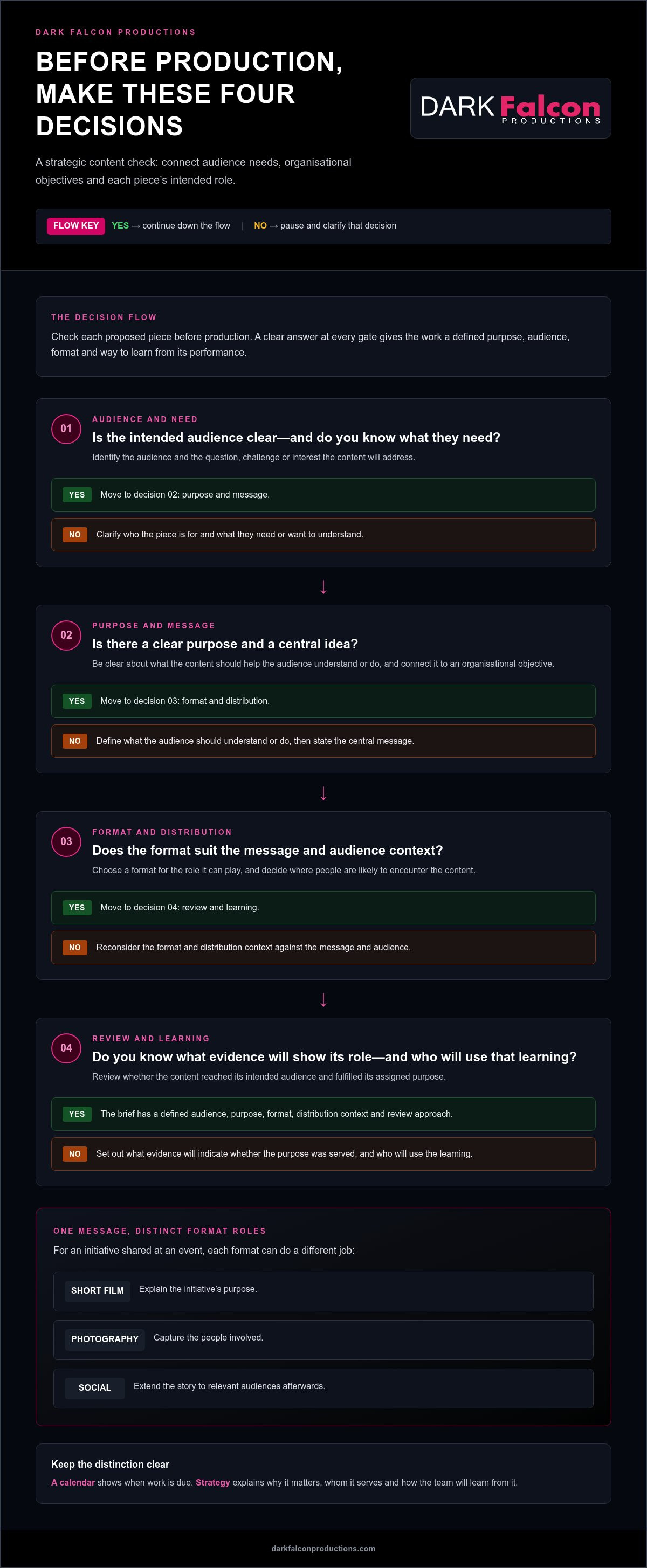
Strategic content development is the process of aligning audience needs, organisational objectives, content choices and performance review so each piece has a clear role. It goes beyond making individual assets or filling a publishing calendar. A calendar shows when work is due; strategy explains why it matters, whom it serves and how the team will learn from it.
What makes content development strategic?
Audience insight should shape the subject, message, format and route to the people who need it. For example, if an organisation wants event attendees to understand a new initiative, a short film might explain its purpose, photography might capture the people involved, and social content might extend the story to relevant audiences afterwards. Each format has a distinct job, rather than being created simply because it is available.
Every choice also needs a connection to a stated objective, such as explaining a service, supporting awareness or helping an audience make an informed decision. The definition of content strategy describes a discipline that guides the planning, development and management of content. Strategic direction sets the intent and boundaries, while leaving creative teams room to find the strongest execution.
What should a content development plan help you decide?
A useful plan turns broad ambitions into decisions a team can act on. It should make clear which audiences need attention, what questions or needs matter to them, and what the organisation wants the content to accomplish. It should also describe each idea’s role, its intended format and the likely context in which people will encounter it.
For each proposed piece, clarify:
- Audience and need: Who is it for, and what question, challenge or interest will it address?
- Purpose and message: What should the content help the audience understand or do, and what is the central idea?
- Format and distribution: Would video, photography, written content or social content suit the message and audience context? Where will people see it?
- Review: What evidence will show whether it served its intended purpose, and who will use that learning?
These decisions help teams prioritise ideas before production begins. They also make review more useful. Instead of asking whether a piece performed well in the abstract, the team can assess whether it reached the intended audience and fulfilled its assigned role. That learning can guide future creative choices without turning the plan into a rigid script.
The foundations of strategic content development: audience, purpose and message
A strong content idea connects audience relevance with organisational purpose. If a team starts only with what it wants to announce, the content may miss the questions people actually have. If it responds only to audience interest, it may not support a wider objective. Strategic content development brings these needs into the same decision, then shapes the message and delivery context around them.
Start with audience needs and business objectives
Look for evidence in customer questions, feedback, search behaviour and conversations with people who work directly with your audience. Separate what people need to know from what the organisation would like to say. Then connect each proposed theme to a specific objective, such as explaining a change or making a complex idea easier to understand. This gives teams a reason to prioritise one idea over another without assuming a particular result.
Consider an organisation preparing to share an initiative at an event. Attendees may need a clear explanation of why it matters, while the organisation wants to communicate its wider purpose. A single core message can serve both: explain the initiative in audience-centred terms, then let each asset emphasise the details suited to its setting.
Turn the strategy into a usable creative brief
A practical brief translates that direction into choices a creative team can act on. Set out the purpose, intended audience, core message and where people are likely to encounter the content. Add format considerations and success measures, but avoid prescribing every shot, phrase or edit. The brief should protect the intent while leaving room for creative judgement. If external collaboration is part of delivery, this guide to choosing a creative media partner can help frame the working relationship.
A consistent message doesn’t require identical assets. A short film might introduce the idea through a concise narrative; event photography could capture real moments that make it tangible; social content could draw out individual points for a particular platform and audience. The message remains recognisable, while format, detail and emphasis adapt to context.
Before commissioning work, use this checklist to test whether the foundations are clear:
- Which audience are we prioritising, and what do they need or want to understand?
- What evidence supports this need, such as audience questions or existing feedback?
- What organisational or communications objective does the content support?
- What is the one message each asset should reinforce?
- Where will the audience encounter it, and what format suits that context?
- What will the team review to judge whether the content served its intended purpose?
If the answers point in different directions, pause before production. Resolve the tension between audience need and organisational intent, then record the agreed choices in the brief. That shared foundation helps writers, producers and editors make connected decisions without flattening their creative contribution. For teams developing visual content, creative production support can carry a clear brief through to execution.
Strategy, content calendars and production: what is the difference?
These terms describe connected parts of content work, but they answer different questions. Confusing them can lead to a busy calendar and a steady stream of assets without a clear reason for either. A useful system keeps strategic direction, practical organisation, creative execution and audience access distinct, while allowing each to inform the next.
| Element | Main purpose | Typical output |
|---|---|---|
| Strategy | Decide which audience needs and objectives deserve attention, and why. | Priorities, messages and guiding principles. |
| Planning | Organise selected work, responsibilities and sequencing. | A content calendar, briefs and assigned tasks. |
| Production | Develop the planned idea into a finished asset. | Edited video, photography or social content. |
| Distribution | Place and adapt finished content for its intended audience and context. | Published or shared content across relevant channels. |
How does strategy differ from a content calendar?
Strategy is the decision-making direction; a calendar is an organising tool. The calendar can show when a campaign film is due, when supporting photography will be shared and who owns each task. It can’t establish whether the campaign addresses a genuine audience need or supports a meaningful objective. The calendar expresses strategy, but does not replace it.
Revisit priorities when the objective changes, audience feedback raises a new need or planned content no longer fits its purpose. Don’t respond automatically by adding more posts. First decide whether the idea remains relevant, needs a different treatment or should give way to something more useful. This keeps strategic content development responsive rather than locked into a checklist.
Does strategic development limit creative freedom?
A clear brief sets the destination, not every step of the journey. It can define the audience, purpose, central message and delivery context without dictating every line, shot or edit. Those boundaries give creative teams a shared foundation, so they can explore strong ideas without losing sight of what the work needs to communicate.
One purpose can take different forms. A short film might use a considered narrative, while social content could be more immediate and event photography could communicate through moments and detail. The creative treatment can vary; the underlying intent should remain recognisable. Cinematic brand storytelling offers a related perspective on shaping narrative choices around a brand’s purpose.
Choose formats and channels for the audience, message and setting, not simply because a trend has made them prominent. A trend may offer a useful creative route, but it isn’t a strategy in itself. Ask whether the format helps people engage with the idea and whether the team can deliver it well. If not, a more fitting approach is likely to make the message clearer.
How to develop content strategically from brief to review
A repeatable workflow keeps a content idea connected to its purpose from the first decision through to learning. Strategic content development moves through six linked stages: define the need, prioritise the work, brief the team, produce the asset, distribute it in context and review what it achieved. Each stage should leave the next team with a clear decision and useful output.
- Define. Decide what audience need and organisational objective the work should address. The content lead, with input from relevant stakeholders, records the intended audience, purpose and evidence behind the idea.
- Prioritise. Decide whether the idea warrants attention now, fits available resources and supports current objectives. The strategy owner makes the call with decision-makers. The output is an agreed priority, a deferred idea or a reason to decline it.
- Brief. Agree the core message, audience context, format considerations and measures of success. The content lead prepares the brief, and stakeholders approve its direction so the creative team has a shared reference.
- Produce. Decide how to express the message in the selected format. The creative lead guides execution with writers, producers, photographers or editors; the output is a finished asset ready for review and use.
- Distribute. Select the channels and adaptations that fit the intended audience and context. The channel owner prepares the publishing or sharing plan, including the approved assets and any platform-specific versions.
- Review. Compare evidence with the original purpose. The content lead and relevant stakeholders record what the audience did, what feedback emerged and what the team learned, then recommend what to continue or change.
Move from a clear brief to purposeful production
Production should interpret the brief, not merely fulfil a format request. If the work is intended to make an initiative understandable to people encountering it at an event, a concise film, event photography or supporting social content may each contribute differently. Choose an execution that suits its use and distribution context, rather than adding complexity that doesn’t serve the message.
Set review points that protect clarity, accuracy and consistency before an asset is released. Assign responsibility for checking factual details, alignment with the agreed message and suitability for its intended channel. This gives creative teams room to develop the work while keeping approval accountable and focused.
Review results and refine the next cycle
Measure against the objective, not a single popularity metric. If the aim was to explain a change, consider relevant audience questions and feedback alongside channel observations. If the aim was to extend awareness, examine suitable reach or engagement evidence. Treat these as signals, not proof of cause: record what was observed separately from what the team believes it means.
Close the review with a practical decision: keep an approach, adjust the message or format, reconsider distribution, or investigate an unanswered question. This turns reporting into direction for the next cycle. Creative production support can carry a considered brief through to purposeful execution.
Bring strategic content development to life through creative production
A strategy becomes tangible through production choices: what to show, what to say and how each asset supports the wider story. Formats should have distinct roles, not simply repeat the same message in different packaging. In strategic content development, creative execution is strongest when it reflects the audience’s context, the content objective, available resources and intended distribution.
Choose creative formats to serve the content objective
Start with the job the content needs to do. Video can carry a narrative over time, bringing together people, places and ideas to explain a subject or convey its character. Event photography can capture moments that add visual detail to a story, whether the aim is to document an occasion or create material for future communications. Neither format is essential for every plan; choose what can make the message clearer for its audience.
Social content can adapt the central idea for the way people encounter it on a particular platform. A longer video might be shaped into shorter edits, while selected photographs can anchor individual posts. Adaptation should preserve the core message and respect the context: what the audience is likely to notice, how much they need to know and what the channel is suited to carry. A trend may inspire a treatment, but it shouldn’t determine the format by itself.
Keep the production scope proportionate. Consider where the asset will appear, how it will be used and what resources are available before deciding on the creative approach. A focused set of well-planned visuals may serve the objective better than producing every possible format. No format guarantees a particular response; select each for its fit with the strategy.
Build consistency across content and channels
Consistency comes from a shared message and deliberate adaptation, not identical assets. A video, a set of photographs and supporting social posts can each emphasise a different aspect of the same idea. Their tone, visual choices and level of detail can shift to suit the audience and channel, while retaining a recognisable point of view.
Coordinate this before production. Agree which parts of the story must remain consistent, which details can change by channel and how each asset will be used. For channel-specific decisions, social media content creation services can help frame how creative material is adapted for platform contexts. In video, editing shapes the flow, emphasis and final delivery of the material, so professional video editing helps bring the intended message through.
Dark Falcon Productions brings video production and editing, event photography and social media management into creative delivery shaped by the project’s purpose. For a visual content idea with a clear strategic foundation, discuss a creative content project.
Give your next content idea a clear direction
Your next step doesn’t need to be a complete overhaul. Choose one upcoming project and use it to test a more deliberate way of working: make the intended audience and purpose explicit, then agree how the team will recognise useful learning. That small shift can create a stronger foundation for future creative decisions.
Dark Falcon Productions supports creative execution, from video production and editing to event photography and platform-focused social media content. The right combination depends on the story you want to tell and where your audience will encounter it. Strategic content development gives the work a defined purpose while leaving room for fresh ideas.
Discuss your next creative content project to explore how to bring your direction to life.
Frequently Asked Questions
What is strategic content development?
Strategic content development is a way to decide what to create, for whom and how to judge its usefulness before work is commissioned. It connects an audience need to an organisational priority, then gives each asset a defined role. For example, a product explainer might answer a recurring customer question, while an internal update gives staff the context they need. That clarity helps teams avoid producing attractive material with no clear purpose.
How is content development different from content strategy?
Content strategy sets the overall direction, including audience priorities, objectives and guiding principles. Content development applies that direction to particular pieces of work, from shaping an idea to preparing it for use. For instance, a strategy may identify that customers need clearer guidance about a service; development turns that need into an explainer, gathers the necessary information and shapes the asset. In a small team, the same person may lead both activities.
Can a small team develop a strategic content plan?
Yes. A small team can create a useful plan by keeping its scope manageable and assigning clear ownership. One person might coordinate priorities, while subject specialists contribute audience questions and check accuracy. Start with a short list of audience needs and select only the content the team can support. A simple shared document can record each idea’s purpose, owner, next decision and review measure. The key is clarity, not a large planning department.
What should a content development brief include?
A brief should give the creative team enough context to make sound decisions. State the intended audience, the problem or question the content addresses, the project objective, the central message, any essential source material and where the asset will be used. Add practical constraints, such as required approvals or information that must be excluded. For example, a technical explainer may need a named subject expert to verify terminology before publication.
How do you measure strategic content development?
Measure whether the work fulfilled its original purpose, using evidence suited to that objective. For a guidance article, this might include reader feedback, support-team observations or whether people can find the answer they need. For an event film, consider its intended audience and distribution context rather than relying on views alone. Record what the data shows separately from interpretation, then note what the team will retain, adjust or investigate next.
How often should a content development strategy be reviewed?
Review it often enough to keep priorities relevant, without changing direction in response to every short-term fluctuation. Set a regular review point that fits your planning cycle, then revisit sooner if objectives shift, audience feedback reveals a new need or a channel changes how people encounter the content. At each review, check whether planned themes still matter, whether ownership remains clear and whether previous learning has informed upcoming work.