
Placing an unattended camera at the back of an auditorium does not constitute a modern conference. For forward-thinking UK organisations, treating remote delegates as passive observers quickly damages brand prestige. Strategic hybrid event production succeeds only when conceived as a synchronised dual-audience broadcast, not a compromised live stream. How do you keep remote attendees genuinely invested without detracting from the physical delegate experience in the room?
You already know the frustration of fragmented budgets, crippling audio latency, and streams that feel like corporate television from a decade ago. Balancing in-person atmosphere with bespoke digital broadcasting shouldn't force you to choose between two half-baked experiences. Discover how professional hybrid event production unites physical and virtual spaces to maximise audience engagement, protect technical delivery, and guarantee long-term content longevity.
This guide examines the core technical architecture, dual-engagement workflows, and multi-platform distribution frameworks needed to execute seamless UK corporate broadcasts in 2026.
Key Takeaways
- Strategic hybrid event production treats the digital broadcast as an independent, television-style experience rather than an afterthought to in-room staging.
- Broadcast-grade multi-camera arrays and dedicated dual-mix audio engineering eliminate the stream latency and acoustic clutter that isolate remote audiences.
- Deliberate touchpoints and synchronised stage direction ensure virtual participants contribute meaningfully rather than observing as passive spectators.
- Rigorous venue audits addressing dedicated upload bandwidth and acoustic control neutralise delivery risks long before live transmission begins.
- Partnering with an end-to-end creative team transforms live session feeds into a high-impact library of social assets, event photography, and strategic video content.
What Is Hybrid Event Production in the Modern Era?
The contemporary standard for corporate gatherings has shifted irreversibly. Modern hybrid event architecture is not a passive feed piped to an external player. Instead, strategic hybrid event production orchestrates two distinct environments simultaneously: an atmospheric in-person live show and a dedicated, television-style digital broadcast. When remote delegates are treated as second-class observers peering through a static lens, engagement collapses and brand prestige takes an immediate hit.
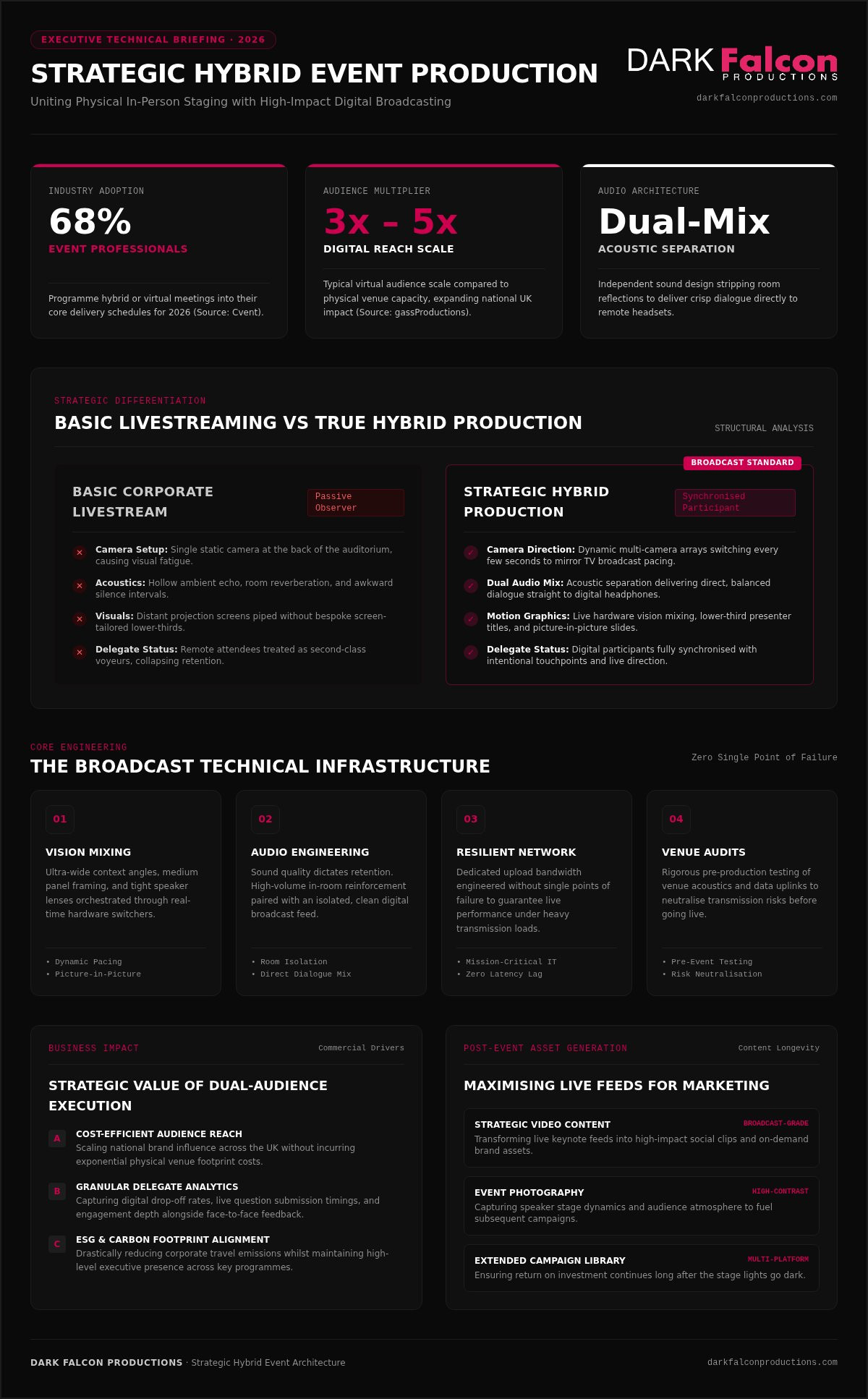
According to research by Cvent, 68% of event professionals programme hybrid or virtual meetings into their schedules for 2026. Delivering on that expectation requires treating the remote participant not as a voyeur, but as a primary viewer who demands broadcast pacing, bespoke lower-thirds, and intentional interaction.
The Distinction Between Livestreaming and True Hybrid Production
Basic livestreaming merely points a camera at a stage, broadcasting ambient echo, awkward pauses, and slides designed exclusively for a distant projection screen. True hybrid production designs an intentional journey for digital screens:
- Broadcast Pacing: Directing dynamic camera cuts, dedicated digital presenters, and tailored on-screen motion graphics to sustain screen-bound attention spans.
- Acoustic Separation: Generating a separate digital audio mix that strips away hollow room reflections, delivering direct, balanced dialogue straight to remote headsets.
- Dynamic Perspectives: Utilizing multi-camera arrays that track presenter energy, audience reactions, and high-impact stage reveals simultaneously.
A corporate webcast is merely functional. Professional production, by contrast, operates like live television.
The Strategic Business Value of a Hybrid Format
Treating both audiences with equal gravity unlocks substantial commercial returns. Data published by gassProductions indicates that the digital audience for a hybrid event is typically three to five times larger than the physical room capacity. This reach scales brand influence across the UK without incurring the exponential venue costs of a larger physical footprint.
Beyond attendance metrics, dual-audience execution provides hard commercial advantages:
- Data Depth: Capturing granular digital analytics on drop-off rates, digital question submissions, and engagement timing alongside face-to-face feedback.
- ESG Alignment: Drastically lowering travel emissions for national teams whilst maintaining high-level executive presence across key discussions.
- Content Lifecycle: Capturing broadcast-quality video and event photography that feed ongoing marketing campaigns long after the stage lights go dark.
The Technical Infrastructure Behind Flawless Hybrid Delivery
Flawless execution requires more than hiring gear; it demands an integrated broadcast engineering framework. When corporate brands present high-stakes keynotes, technical instability destroys credibility within seconds. True hybrid event production relies on an interconnected ecosystem of video, sound, and data transmission designed to operate without single points of failure. Just as public bodies build mission-critical networks, contemporary productions depend on resilient hybrid IT infrastructure that guarantees performance under high load.
Vision Mixing and Multi-Camera Direction
Static framing quickly fatigues digital viewers. A professional camera setup employs distinct perspectives: an ultra-wide context angle, medium shots of panel dynamics, and tight lenses tracking the keynote speaker's expressions.
Live vision mixers guide viewer attention by switching camera angles every few seconds, mirroring television broadcast pacing. Hardware switchers insert live motion graphics, lower-third presenter titles, and picture-in-picture presentation slides cleanly. This real-time composition keeps remote delegates focused on the subject matter rather than eye strain.
Audio Engineering: The Linchpin of Digital Engagement
Sound quality dictates remote attendee retention. While viewers readily tolerate minor visual anomalies, garbled audio causes immediate disengagement. Sound engineering for hybrid spaces requires two distinct sound environments:
- Acoustic Isolation: In-room speakers need high-volume reinforcement, while digital streams demand clean, compressed feeds without venue reverb.
- Mix-Minus Routing: Dedicated audio engineers configure mix-minus paths so remote presenters hear live questions without their own voices echoing back.
- Feedback Suppression: Hardware DSP routing prevents high-frequency interference between boundary microphones and venue sound systems.
Failsafe Network Redundancy and Power Protocols
Reliability requires deliberate technical contingency planning. Production workflows cannot depend on shared venue Wi-Fi or unshielded wall sockets:
- Bonded Connectivity: Enterprise broadcasts utilise dedicated symmetric fibre backed up by bonded 5G cellular arrays, switching streams instantly if the primary link fails.
- Isolated Power Supplies: Uninterruptible power supplies (UPS) protect video switchers and encoding hardware from unexpected venue voltage fluctuations.
- Local ISO Recording: Cameras record internal high-bitrate backups independently of the live stream feed, guaranteeing clean master footage for post-event edits.
Working alongside an experienced creative partner like Dark Falcon Productions ensures your technical routing, multi-camera arrays, and audio engineering function as one cohesive broadcast machine across the UK.
Designing Synchronised Engagement for Two Audiences
The core challenge of hybrid event production is psychological, not technical. How do you bridge the emotional divide between an audience sitting in an auditorium and another watching alone at their desks? When remote participants feel ignored, their retention drops and their attention turns to email inboxes. Seamless delivery requires deliberate interaction points woven into the show caller's cues, ensuring equal value across both viewing environments.
According to research from EventTrack, 61% of consumers report being more inclined to purchase from a brand after attending an engaging branded event. Achieving that return demands synchronised participation where remote delegates are visible, audible, and actively involved in stage conversations.
The Role of the Dedicated Virtual Host
Never leave remote screens staring at an empty stage during scheduled physical breaks. A dedicated digital compère serves as an anchor, conducting backstage interviews, unpacking session key points, and translating online chat sentiment directly into the live broadcast.
During panel sessions, this host speaks directly into a dedicated broadcast camera. They read submitted remote questions straight to key speakers, ensuring virtual delegates hold equal weight with in-room microphone queues.
Unified Interactive Tools and Audience Polling
Engagement fractures when platforms separate audiences into walled silos. Synchronised engagement requires unified platforms where actions inside the room and actions online affect the same real-time data:
- Live Aggregated Polling: Mobile app responses from delegates in physical seats combine instantly with browser clicks from virtual attendees.
- Integrated Stage Visualisations: Venue LED backdrops display live word clouds and poll outcomes powered equally by digital and in-person inputs.
- Moderated Digital Chatrooms: Dedicated community managers field technical queries and facilitate structured peer networking without interrupting podium audio.
Pacing, Content Length, and Digital Attention Spans
Attention fatigue operates differently across formats. In-person attendees happily absorb 60-minute panel debates because room ambiance and peer energy sustain their focus. Remote viewers, working across laptop displays, experience steep engagement declines after twenty minutes of unbroken monologues.
Production teams must structure run-of-show scripts into concise chapters. Intersperse live keynotes with short, pre-produced brand vignettes, dynamic panel swaps, and focused question breaks. This intentional rhythm prevents digital drop-off whilst enhancing the live energy inside the auditorium.
The Pre-Production to Post-Event Delivery Framework
High-calibre live broadcasts succeed weeks before the first flight case opens. Technical friction on show day almost always stems from insufficient pre-production planning. A rigorous delivery framework eliminates operational variables, synchronising production teams, staging crews, and executive speakers around a unified script. Strategic hybrid event production bridges the gap between live show-calling and long-term marketing performance, ensuring that valuable moments captured on stage continue working for your brand.
Step 1: The Technical Venue Audit and Creative Concept
Never rely on a venue's self-reported technical specifications. An on-site survey evaluates ambient light control, ceiling suspension points, and potential acoustic spill from adjoining conference spaces. Crucially, engineering teams verify dedicated, symmetrical upload bandwidth isolated entirely from general delegate Wi-Fi networks.
During this preliminary phase, creative direction crystallises. You establish visual identity, screen graphics, stage layout, and whether the narrative suits a broadcast studio setting or an expansive auditorium aesthetic.
Step 2: Technical Rehearsals and Remote Speaker Briefings
Dry runs protect live delivery. The production desk tests every video cue, graphic lower-third, and microphone changeover in sequence alongside the full run of show.
- Speaker Technical Onboarding: Pre-event dial-ins confirm remote contributors use adequate directional microphones, flattering front lighting, and stable hardwired connections.
- Comms Channels: Production directors, vision mixers, stage managers, and virtual hosts maintain private multi-channel intercom links to handle spontaneous schedule shifts smoothly.
- Latency Synchronization: Live line tests measure and align audio delays between venue speakers and digital encoders.
Step 3: Post-Production and Strategic Content Repurposing
Most corporate broadcasts end the moment the stream terminates. This represents a significant missed opportunity. An intelligent production workflow treats live multi-camera feeds and on-site event photography as raw material for an entire campaign of brand assets:
- Modular Keynotes: Long presentations are segmented into discrete, high-resolution training modules and gated digital content. Hosting these assets within high-converting web portals built by digital specialists like XcellentDigital allows organisations to turn conference recordings into enduring lead-generation engines.
- Short-Form Video: Editors extract punchy, vertical video cuts from standout speaker moments, formatted specifically for cross-platform distribution.
- Cinematic Highlight Films: Master footage combines with editorial event photography to capture room energy, driving delegate ticket registrations for future dates.
To turn your next corporate broadcast into an engine for ongoing marketing collateral, partner with Dark Falcon Productions for comprehensive creative direction, live multi-camera production, and strategic video editing across the UK.
Selecting a Strategic Creative Production Partner in the UK
The difference between a forgettable stream and an authoritative corporate broadcast comes down to who directs the vision. Many businesses mistake standard equipment hire for comprehensive staging. However, technical logistics alone cannot capture room energy or sustain remote viewers. True hybrid event production demands a dedicated partner who manages visual storytelling, broadcast switching, and content extraction as one unified creative discipline.
According to research by Swoogo and Gatepoint Research, 55% of event marketing teams manage more than 20 events per year. At this operational tempo, fragmented supplier handoffs introduce friction. Consolidating your production under a single creative team protects brand authority and maximises the return on every session staged.
Creative Storytelling Versus Passive Gear Hire
Transactional hire companies drop flight cases at the venue door and monitor volume levels. They rarely consider audience psychology, camera compositions, or broadcast pacing. A creative production partner approaches the brief like an executive television director.
They align dynamic stage lighting, brand lower-thirds, and presenter framing with your broader commercial identity. When planning your event architecture, explore how to assess a creative media production partner who treats your core mission as the primary design driver rather than an afterthought.
Integrating Video Production with High-Calibre Photography
Managing disparate vendors on event day creates visual clutter, unnecessary friction, and clashing production styles. Bringing camera operators and still photographers under one shared direction changes the outcome entirely:
- Staging Synergy: Unified crews coordinate shooting angles, preventing photographers from walking into live broadcast frames during high-stakes presentations.
- Aesthetic Uniformity: The colour grades applied to your video recordings match the tone, contrast, and style of your still imagery.
- Comprehensive Coverage: Discover how professional event photography services document crucial business milestones and delegate networking alongside live multi-camera broadcasts.
Future-Proofing Your Event Content Strategy
A live broadcast should never exist in isolation. Modern marketing strategies require continuous asset extraction to validate event spend. Selecting a partner with an established post-production pipeline ensures your keynote recordings quickly turn into high-impact social clips, executive thought leadership, and promotional reels.
Review how strategic commercial video production scales brand authority nationwide. By choosing a dedicated team capable of managing creative direction, multi-camera switching, and post-event delivery, your organisation turns single-day events into lasting marketing assets.
Elevate Your Live Broadcast Beyond the Conventional
Executing an ambitious corporate gathering requires more than linking cameras to a video feed. Modern hybrid event production unites in-person energy with broadcast-grade television direction, keeping remote delegates engaged while protecting your brand's authority. Treating both physical and digital audiences with equal design priority guarantees that every attendee receives measurable value.
Technical stability, acoustic precision, and intentional pacing turn what could be a static presentation into an immersive live broadcast. By viewing the live show as the foundation of an ongoing visual strategy, you unlock a wealth of post-event media assets that sustain engagement across your digital marketing channels.
Dark Falcon Productions provides national UK coverage for organisations seeking broadcast-calibre production, cinematic multi-camera video, and refined commercial photography. Our integrated post-production suite ensures your live keynotes, panel discussions, and milestone moments continue driving brand impact long after the applause subsides. Ready to transform your upcoming corporate gathering into a dynamic dual-audience broadcast? Collaborate with Dark Falcon Productions for your next event and command the attention your message deserves.
Frequently Asked Questions
What is the difference between a webcast and full hybrid event production?
A webcast is simply a static, one-way broadcast of a presentation, typically relying on a single camera. In contrast, comprehensive hybrid event production treats the digital stream as an interactive television broadcast synchronised with the live venue. It incorporates multi-camera vision mixing, separate audio mixes for virtual attendees, curated motion graphics, and bidirectional engagement tools that connect physical delegates and remote viewers in real time.
How much bandwidth is required on-site to stream a high-definition hybrid event?
High-definition 1080p broadcasting requires a dedicated upload speed of at least 15 to 20 Mbps, whilst 4K streams demand upwards of 35 Mbps. This connection must be symmetrical, hardwired, and isolated entirely from general venue Wi-Fi used by delegates. To prevent bitrate drops or buffering during critical sessions, enterprise setups always maintain a secondary bonded cellular connection as an automatic failover.
Can remote speakers present live to both the in-room audience and virtual attendees?
Yes, remote speakers can address both audiences seamlessly through dedicated mix-minus audio and video routing. Their video feed appears on large-format venue projection screens or LED walls whilst being integrated directly into the live broadcast switcher. Stage monitors let in-room panellists speak naturally with remote contributors without hearing their own audio delayed, eliminating distracting echo and latency.
How do you keep virtual attendees engaged throughout a full-day conference?
Maintaining engagement requires structuring the agenda around digital attention limits rather than traditional auditorium timelines. Break sessions into focused, twenty-minute chapters separated by dynamic speaker transitions and pre-recorded spotlight media. Employ a dedicated virtual host who speaks straight down the lens to conduct backstage interviews, guide remote discussions, and field digital audience questions directly to stage presenters.
What contingency plans protect a live hybrid event against venue internet failure?
Professional hybrid event production relies on multi-path network bonding rather than a solitary venue line. If the primary fibre network drops, bonded hardware switchers fail over automatically to high-speed 5G cellular arrays without interrupting the stream. Concurrently, all cameras record uncompressed master footage locally onto internal storage media, ensuring your recorded assets remain completely protected regardless of network stability.
Why should a brand hire a creative production team instead of renting AV equipment?
Equipment hire companies merely supply hardware, leaving visual narrative, audience retention, and brand presentation entirely to you. A dedicated creative team directs the live environment like an executive broadcast studio. They manage multi-camera choreography, lighting design, audio engineering, and live direction as one cohesive visual language, safeguarding brand prestige whilst ensuring your message resonates powerfully across both viewing formats.
How quickly can edited video highlights and photography be delivered after the event?
Delivery timelines depend on project requirements, but integrated creative production teams often provide edited still photography within 24 to 48 hours for immediate press and social release. Cinematic highlight reels, keynote chapter cuts, and vertical video shorts for digital channels typically follow within several working days. This rapid turnaround allows organisations to maintain post-event marketing momentum whilst delegate enthusiasm remains high. To capitalise on this window, businesses often explore Custom Web Development and Digital Marketing Services to deploy dedicated campaign microsites and targeted follow-up strategies.